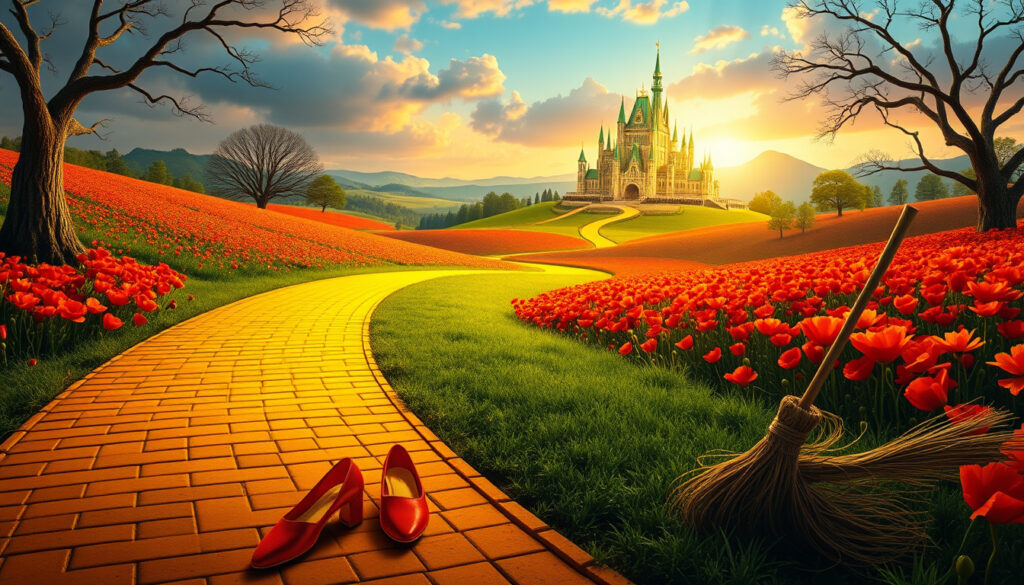
Wizard of Oz Characters: List, Roles & Symbolism
If you’ve ever hummed “Over the Rainbow” or traced the Yellow Brick Road in your mind, you already know the shape of these characters — even if you’ve only seen the film. L. Frank Baum’s original novel, published in 1900, introduced a cast that has since become shorthand for human desires: the need for a brain, a heart, courage, and a way home. But the book and the 1939 film tell their stories differently, swapping silver slippers for ruby red and adding Kansas backstory that Baum never wrote. This guide maps all of it — who appears, what they want, what they symbolize, and where the book and movie diverge.
Core Characters: Dorothy, Scarecrow, Tin Woodman, Cowardly Lion, Wizard · Key Antagonists: Wicked Witch of the West, Wicked Witch of the East · Publication Year: 1900 · Film Release: 1939 · Iconic Ensemble: 5 travelers on Yellow Brick Road
Quick snapshot
- Dorothy is 11 years old in the novel History Collection
- The 1900 novel introduced the core five companions SparkNotes
- The 1939 film cast includes Judy Garland as Dorothy History Collection
- Exact “10 main characters” varies by source — book vs. film lists differ
- How much political allegory Baum intentionally wrote remains debated
- South Witch’s role in the expanded Oz universe is inconsistently documented
- 1900: The Wonderful Wizard of Oz published History Collection
- 1902: Broadway production adds explicit political references Wikipedia
- 1939: MGM film brings Technicolor ruby slippers Collider
The table below summarizes the essential cast information across both the 1900 novel and the 1939 film.
| Label | Value |
|---|---|
| Protagonist | Dorothy Gale |
| Companions | Scarecrow, Tin Woodman, Cowardly Lion |
| Antagonist | Wicked Witch of the West |
| Allies | Glinda, Munchkins |
| Book Author | L. Frank Baum |
| Film Toto | Terry the dog |
“Oz operates on two levels, one literal and puerile, the other symbolic and political.”
— Quentin Taylor, History Collection
Who are the 10 main characters in The Wizard of Oz?
Counting the main characters depends on whether you’re working from the 1900 novel or the 1939 film — and different reference sources give slightly different lists. The core ensemble in both versions centers on five travelers who meet on the Yellow Brick Road, but extended lists typically pull in supporting figures who drive the plot forward. Below is the most commonly cited roster, blending book and film canon.
The five companions Dorothy meets are the Scarecrow, the Tin Woodman, and the Cowardly Lion, all encountered on the road from Munchkin Country to the Emerald City. These three join Dorothy voluntarily, each hoping the Wizard can solve a personal lack — brains, a heart, and courage respectively. Their loyalty forms the emotional backbone of the story.
Dorothy Gale
Dorothy is an 11-year-old orphan girl who lives in Kansas with her Aunt Em and Uncle Henry, tending the farm alongside her dog Toto. Scholar Quentin Taylor noted that “Oz operates on two levels, one literal and puerile, the other symbolic and political” (History Collection). In Baum’s novel, Dorothy is described as perfectly content on the farm despite hardships, while the film emphasizes her dissatisfaction with prairie life and her longing to escape to somewhere “over the rainbow” (GradeSaver).
The Scarecrow
The Scarecrow is the first companion Dorothy encounters, a figure stuffed with straw who believes he has no brains. Despite this self-perceived deficiency, he proves loyal, resourceful, and increasingly intelligent throughout the journey. At the story’s end, he becomes the ruler of the Emerald City when the Wizard departs — a role that suggests his perceived lack was never real (SparkNotes).
The Tin Woodman
Formerly a human woodcutter, the Tin Woodman’s body has been entirely replaced by tin after a witch enchanted his axe. He wishes for a heart from the Wizard but already demonstrates kindness and concern for others throughout the journey. In the novel, his compassion toward the Queen of the Fieldmice ultimately saves the Cowardly Lion from the deadly poppy field (Hyaroo). The film removes this plot point, having Glinda rescue the companions instead.
The Cowardly Lion
The Lion claims to be the King of Beasts but is terrified of conflict — yet he repeatedly shows bravery when his companions need him. He hopes the Wizard will grant him courage, but his actions throughout the story suggest he already possesses it. At the story’s end, he becomes ruler over the beasts of the southern forest (SparkNotes).
The Wizard of Oz
The Wizard appears differently to each character in the novel: to Dorothy as a luminous head, to the Scarecrow as a beautiful woman, to the Tin Woodman as a fearsome five-eyed beast, and to the Lion as a ball of fire (Mental Floss). He is ultimately revealed to be Oscar Diggs, a circus performer from Omaha, Nebraska — a humbug who cannot truly grant brains, hearts, or courage but exploits the characters’ desires. The 1939 film adds Kansas alter-ego Professor Marvel, a detail Baum never wrote (Collider).
The Wicked Witch of the West
The primary antagonist, the Wicked Witch of the West enslaves the Winkies and obsessively pursues Dorothy to recover her sister’s magical slippers. She underestimates Dorothy’s courage and ultimately melts when the girl throws water on her. The Wicked Witch represents the characters’ deepest fears — loneliness amid a world that sings and dances (GradeSaver).
The Wicked Witch of the East
The Wicked Witch of the East dies when her house lands on her in Munchkin Country, inadvertently freeing Dorothy to claim the magical slippers. Her death triggers the celebration from Munchkins and sets the story in motion. She is the less-developed sister, serving primarily as an inciting incident.
Glinda the Good Witch of the North
Glinda appears as a beneficent figure who explains the slippers’ power to Dorothy and later helps the companions escape the poppy field. In the novel, her protective kiss on Dorothy’s forehead visibly prevents flying monkeys from killing the girl, but the film largely omits this detail (Mental Floss). Glinda’s role as a magical helper who grants agency contrasts with the Wizard’s manipulative fraudulence.
Aunt Em and Uncle Henry
Dorothy’s aunt and uncle in Kansas are caring but weary from farm life. They function as Dorothy’s anchor to home, making her eventual return meaningful. The film develops them more fully than the novel, giving Dorothy’s longing for them emotional weight that Baum’s simpler text does not.
The implication: these ten characters form the story’s engine — five seekers, one fraud, two witches, one guide, and two caretakers whose presence defines what Dorothy is fighting to return to.
“The ruby slippers ultimately symbolize Dorothy’s power to transport herself home and the fact that she had access to her desires all along.”
— GradeSaver
What does each character in The Wizard of Oz want?
Every major character in The Wizard of Oz is defined by a want that drives them onto the Yellow Brick Road. These desires are not incidental — they structure the plot, give the companions something to argue about, and ultimately determine what “success” means at the story’s end. The wants also expose something counterintuitive: the characters often possess what they think they lack before the Wizard ever intervenes.
Dorothy’s desire
Dorothy wants to go home. This is the simplest stated desire in the story, yet it carries enormous weight because she only achieves it after learning that the power was hers all along. Her ruby slippers (or silver in the novel) allow her to leave Oz at any moment — a fact Glinda withholds until Dorothy is ready to understand it. The ruby slippers ultimately symbolize Dorothy’s power to transport herself home (GradeSaver), making her journey a loop rather than a linear escape.
The Scarecrow’s need
The Scarecrow wants brains — specifically, he believes he needs a diploma or formal intelligence to be smart. But his problem-solving throughout the story consistently contradicts his self-assessment. He reasons through obstacles, leads the group when Dorothy hesitates, and ultimately rules the Emerald City better than the Wizard ever did. His want exposes the difference between self-perception and actual capability.
The Tin Woodman’s wish
The Tin Woodman wants a heart. His tragedy is that a witch once enchanted his axe, causing him to accidentally chop his own body parts until he became fully tin. Despite this, he feels emotions deeply and acts with kindness — but he cannot believe his own empathy counts as a “real” heart without the Wizard’s approval. The Tin Woodman’s journey interrogates what it means to deserve love.
The Cowardly Lion’s goal
The Lion wants courage. He blusters and roars but flees from danger, yet he repeatedly stands his ground when his companions are threatened. Each act of bravery — however reluctant — builds evidence that he already possesses what he seeks. His cowardice is not absence of courage but fear that one must act despite.
The Wizard’s role
The Wizard wants to maintain his facade. He has no magical power but uses balloon machinery, projections, and psychological manipulation to appear formidable. When Toto pulls back the curtain, his control collapses instantly. His want to preserve illusion is the inverse of the companions’ honest desires — a contrast that defines the story’s moral center.
What does each character represent in The Wizard of Oz?
Scholars have long read The Wizard of Oz as an allegory, with characters functioning as symbols for identifiable social and political forces. The most prominent interpretations focus on economics, gender, and the nature of American idealism — layers that coexist in Baum’s text rather than replacing one another.
Symbolic meanings
The Populist allegory reading, popularized in the 1960s and supported by Wikipedia’s analysis of political interpretations, maps the characters to recognizable American constituencies from the 1890s. The Scarecrow represents farmers, who were often dismissed as lacking education. The Tin Woodman represents industrial workers, stripped of humanity by factory conditions. The Cowardly Lion represents politicians — specifically William Jennings Bryan, a Populist leader who blustered but ultimately folded under pressure.
The Yellow Brick Road itself symbolizes the gold standard, which Populists opposed in favor of free coinage of silver. Populists supported free coinage of silver as an alternative to the gold standard (Mental Floss), and Baum’s choice of silver slippers in the original novel reportedly reflects this economic stance. The road is inaccessible to those without the means to walk it — a critique embedded in the geography of Oz.
Populist allegory interpretations
Dorothy herself symbolizes the average American, representing a young nation that won independence from an older force and idealistically believes in opportunity (History Collection). She is not a politician, farmer, or worker but an ordinary person caught between larger forces — the tornado that lifts her from Kansas parallels the social upheavals that displaced agrarian Americans in the 1890s.
An interpretation that has gained wide traction in recent years is that Baum’s book may be an allegory for feminism (Wikipedia). All of the characters in The Wizard of Oz that have any tangible power happen to be females — Glinda, the Wicked Witch of the West, and even the Good Witch of the South. The Wizard, by contrast, is a fraud; the male companions seek their deficiencies to be corrected. This reading highlights how female characters in the story hold agency while male figures are defined by lack.
Who are the four witches of Oz?
The witch population of Oz extends beyond the two Wicked Witches most readers remember. Baum’s Oz universe contains four named witches, each occupying a distinct cardinal direction and serving different narrative functions.
The Wicked Witch of the East
As noted above, the Wicked Witch of the East dies early in the story when Dorothy’s house lands on her. Her only function is to trigger the plot — her death releases the magical slippers and earns Dorothy a celebration from the Munchkins. She is the least developed of the four, serving as a catalyst rather than a character.
The Wicked Witch of the West
The primary antagonist, the Wicked Witch of the West is the sister of the East Witch and rules the Winkies with an iron hand. Her obsession with recovering the ruby slippers drives the second half of the story. Her vulnerability to water — revealed when she melts — is a detail the film preserves faithfully from the novel.
Glinda the Good Witch of the North
Glinda occupies the northern quadrant of Oz and serves as Dorothy’s primary guide. She instructs the girl in the slippers’ power, helps her escape the poppy field in the film, and sends her home at the story’s climax. In the novel, her protective kiss actively shields Dorothy from the flying monkeys — a detail the film undercuts by barely showing the mark.
Good Witch of the South
The fourth witch, sometimes called the Witch of the South, appears primarily in later Oz books rather than The Wonderful Wizard of Oz itself. Her prominence varies by source; some Oz reference lists mention her as an equal counterpart to Glinda, while others treat her as a secondary figure in the expanded universe. Her exact role in the first novel is limited, making her inclusion in witch counts a source of variation across reference lists.
Who are the male Wizard of Oz characters?
Separating the cast by gender reveals a striking imbalance: the story’s active power — magic, protection, punishment — sits almost entirely with female characters, while the male characters are defined by lacks they hope to correct. This split is especially visible when examining the core companions.
The Scarecrow
The first male companion Dorothy meets, the Scarecrow functions as the logical voice of the group despite believing he has no brains. He is played by Ray Bolger in the 1939 film, and his gentle awkwardness defines the character for most modern audiences. His final role as ruler of the Emerald City is the most prominent position any male character achieves in the story.
The Tin Woodman
The Tin Woodman represents the industrial worker — a formerly human figure literally replaced by machinery. He is played by Jack Haley in the 1939 film, with the role recast from Buddy Ebsen, who initially could not tolerate the makeup and nearly died from an allergic reaction. His compassion and his desire for a heart make him the emotional center of the trio.
The Cowardly Lion
Bert Lahr plays the Lion in the film, bringing comic bravado to a character whose fear is his defining trait. Lahr’s performance — roaring, blustering, ultimately brave — set the template for the character that persists in adaptations. His final role as ruler of the southern forest’s beasts parallels the Scarecrow’s elevation in the Emerald City.
The Wizard
Frank Morgan plays the Wizard in the 1939 film, and the role encompasses both the Oz fraud and his Kansas alter-ego Professor Marvel. The Wizard is the story’s central male figure, but his power is entirely illusory — his exposure as a humbug defines the narrative’s moral lesson about self-sufficiency.
Uncle Henry
Dorothy’s Uncle Henry is a quiet presence in both book and film, representing the stable Kansas home she seeks to return to. He is less developed than Aunt Em and serves primarily as a marker of domestic normalcy rather than a character with agency or desires of his own.
The trade-off: male characters in The Wizard of Oz are largely defined by what they lack — brains, heart, courage — while female characters possess the actual power to change outcomes. This structural choice, whether intentional or not, reinforces the feminist reading of Baum’s text: the characters who can act wield magic, while the characters who seek agency must petition a fraudulent authority for permission.
The 1939 film omits Baum’s silver slippers in favor of ruby red to showcase Technicolor. This cosmetic change altered how generations perceive the story’s economic symbolism — the silver-to-ruby swap removed a direct reference to the free silver movement that Populists championed in the 1890s.
Baum wrote 14 Oz books and the 1939 film became more famous than any of them. For most modern audiences, “Wizard of Oz” means Judy Garland, ruby slippers, and “Over the Rainbow” — not the 1900 novel’s locked glasses, Emerald City facade, and silver slippers. Understanding which version of the story you’re reading matters because the characters’ meanings shift depending on the medium.
Related reading: Harry Potter and the Goblet of Fire – Full Summary and Guide · Map of Middle Earth – Regions, History and Interactive Guides
The Wizard of Oz characters’ iconic roles and symbolism gain depth from the 1939 films plot and cast exploring the movie’s narrative, ensemble performances, and cultural legacy.
Frequently asked questions
What are 5 major characters?
The five core characters are Dorothy Gale, the Scarecrow, the Tin Woodman, the Cowardly Lion, and the Wizard of Oz. These five form the central ensemble — Dorothy as protagonist, her three companions seeking correction from a humbug Wizard who cannot actually grant their wishes.
Who is the Tin Man in Wizard of Oz?
The Tin Man, officially called the Tin Woodman, is a companion who was enchanted by a witch and rebuilt entirely in tin. He seeks a heart from the Wizard but already demonstrates compassion throughout the journey. In the 1939 film, he is played by Jack Haley.
Who plays Wizard of Oz characters in 1939 film?
Judy Garland plays Dorothy, Ray Bolger plays the Scarecrow, Jack Haley plays the Tin Man, Bert Lahr plays the Cowardly Lion, and Frank Morgan plays the Wizard. Terry the dog plays Toto. Each actor defined their character for subsequent adaptations.
What do Wizard of Oz characters’ costumes look like?
Dorothy wears a blue-and-white gingham dress with a pinafore. The Scarecrow wears a tattered straw-stuffed suit with a burlap mask. The Tin Woodman is covered in tin sheets with a painted face. The Lion wears a shaggy brown costume with a mane. The film costumes emphasized distinct silhouettes so each character reads clearly in Technicolor.
In what order do Wizard of Oz characters appear?
Dorothy and Toto appear first, followed by Miss Gulch (Kansas only). The tornado carries Dorothy to Oz, where she meets Glinda, then the Munchkins. The Scarecrow meets Dorothy on the Yellow Brick Road, followed by the Tin Woodman and the Cowardly Lion. The Wizard appears last, as the destination.
Who are the female Wizard of Oz characters?
The primary female characters are Dorothy Gale, Aunt Em, Glinda the Good Witch, the Wicked Witch of the West, and the Wicked Witch of the East. Notably, the female characters in Oz hold the actual magical power — Glinda guides, the Wicked Witch threatens, and Dorothy wields the slippers. Male characters seek correction; female characters act.
Is Toto a main Wizard of Oz character?
Toto is Dorothy’s dog and appears throughout the story in both book and film. He is responsible for Dorothy being whisked away to Oz and for exposing the Wizard as a fraud by pulling back the curtain. He functions as a supporting character rather than a main protagonist but is indispensable to the plot.
How many witches are in The Wizard of Oz?
Four witches are referenced in Oz lore: the Wicked Witch of the East, the Wicked Witch of the West, Glinda the Good Witch of the North, and the Good Witch of the South. The first novel focuses on two, but expanded Oz canon names all four. The South Witch plays a minimal role in Baum’s first book, making her inclusion in “four witches” counts dependent on later texts.
More related posts
 Baltimore Ravens vs Pittsburgh Steelers: Playoff Fallout
 Wordle New York Times: How to Play, Hints, and History
 Grosse Pointe Garden Society Cast, Cancellation, and Streaming
 Wisconsin Badgers Men’s Basketball 2025-26: News & Schedule
 Allpoint ATM Near Me: Fees, Limits & Locations
 Wordle Unlimited: Play Free Endless Word Games Online
 Alavés vs Real Madrid: H2H Record, Stats & 2-1 Win
 IRS Tax Withholding Estimator 2025: How to Use It Correctly