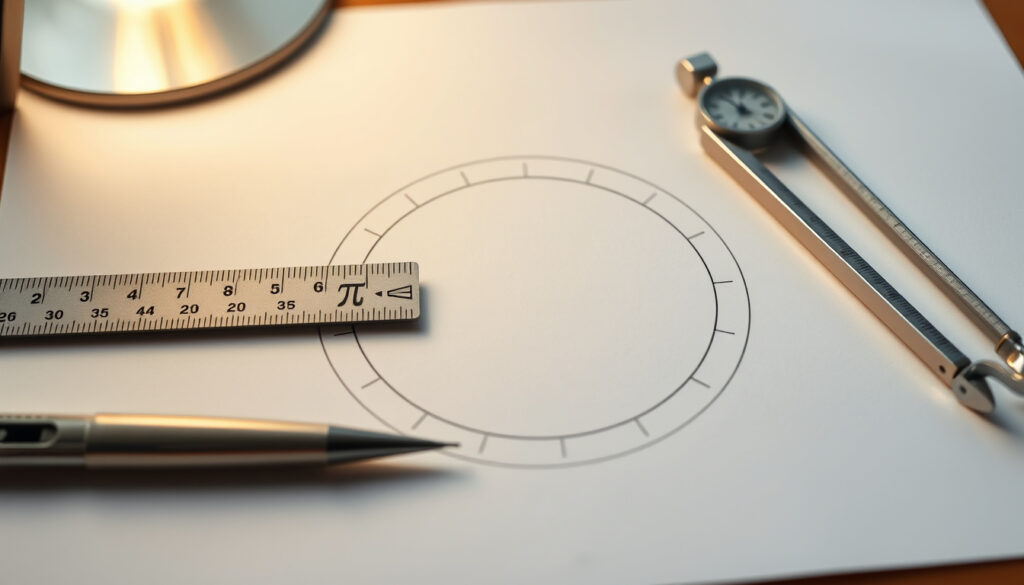
Area of a Circle: Formula, How to Calculate & Examples
Whether you’re sizing up a new garden planter, calculating materials for a round patio, or wrestling with a geometry assignment, the area of a circle comes up more often than most people expect. The formula is straightforward, but getting a feel for how it works—and when to reach for a calculator instead of pencil and paper—makes all the difference. Below is a complete guide to everything you need.
Formula: πr² · Pi value: 3.14159 · Diameter formula: π(d/2)² · Unit example: Square units · Resource: Video lesson available
Quick snapshot
- π cannot be expressed as an exact fraction (BYU-Pathway Resource Center)
- Precision needed varies by application (BYU-Pathway Resource Center)
- Archimedes derived the formula using regular polygons (Wikipedia)
- Modern mathematics confirms this approach (Wikipedia)
Six key values, one core relationship: π connects radius, diameter, and area across every size circle.
| Label | Value |
|---|---|
| Standard Formula | πr² |
| Pi Approximation | 3.14 |
| Diameter Version | π(d/2)² |
| Example (r=5) | 78.5 cm² |
| Full Pi Value | 3.141592653… |
| Radius Definition | Half of diameter |
What is a formula for area of a circle?
The standard formula for calculating the area of a circle is A = πr², where A represents the area, π (pi) is the mathematical constant approximately equal to 3.14159, and r is the radius of the circle (BYU-Pathway Resource Center). The radius is the distance from the center of the circle to any point on its circumference, and it is always half the size of the diameter (BYU-Pathway Resource Center).
Pi r squared explained
Understanding why this formula works starts with what π actually represents. The symbol π (pi) is the constant ratio of the circumference of any circle to its diameter—meaning if you measure all the way around a circle and divide by the distance across it, you always get π (Wikipedia). This constant appears in every calculation involving circles because it is built into the geometry of the shape itself.
π is approximately 3.14 for practical calculations, but the full value extends to an infinite number of decimal places without repeating (BYU-Pathway Resource Center). Most everyday math problems don’t need more precision than 3.14.
Role of pi in the formula
When Archimedes derived the circle area formula, he viewed the circle as the limit of a sequence of regular polygons with an increasing number of sides (Wikipedia). The area of a regular polygon equals half its perimeter multiplied by the distance from its center to its sides. For a circle, this simplifies to A = 1/2 × 2πr × r, which gives us A = πr².
The implication: this formula works for any circle, whether it is the size of a coin or the cross-section of a pipeline.
How to use 3.14 to find the area of a circle?
Using 3.14 as the value for π gives you a practical approximation that works well for school-level math and everyday estimates. For a circle with radius 3 m, applying A = 3.14 × (3)² yields an area of approximately 28.27 m² (Math is Fun). This approximation introduces only a tiny margin of error—less than 0.1%—compared to using the full π value.
Step-by-step with approximation
To calculate the area using 3.14 as your pi value, follow these three steps: measure the radius, square that radius value, then multiply by 3.14. For a circle with a 5 cm radius, squaring 5 gives 25, and 3.14 × 25 equals approximately 78.5 cm² (Albert.io).
Example calculations
Working through a diameter-based example helps cement the method. For a circle with a 12-inch diameter, the radius is 6 inches. Using A = 3.14 × (6)² produces approximately 113 square inches (Albert.io). This confirms that whether you start with radius or diameter, the result follows the same geometric logic.
What this means: once you know any one measurement (radius, diameter, or circumference), you can work backward or forward to find the area.
What does πr² mean?
The notation πr² breaks down into two parts that each contribute to understanding the formula. The r² (radius squared) accounts for the two-dimensional nature of area—squaring the radius because you are measuring coverage across both dimensions of the plane. Multiplying by π scales that squared radius to match the circular shape rather than a square.
Breaking down πr²
Khan Academy teaches that the area of a circle is pi times the radius squared (A = πr²) and this relationship holds true regardless of how the circle was measured (Khan Academy). The formula can be visualized by dividing a circle into thin strips that approximate a rectangle with base πr and height r—showing geometrically why these elements multiply to give the total area.
Why squared radius
The radius gets squared because area in two dimensions requires two length measurements. If you imagine a circle inscribed in a square, the radius squared relates to the space covered within that two-dimensional boundary. The circumference formula (C = πd = 2πr) follows a similar logic but produces a one-dimensional measurement instead, which is why the exponent changes between circumference and area formulas (Dummies.com).
The catch: students sometimes confuse area and circumference formulas. Remember that circumference is a line measurement (one dimension) while area measures coverage (two dimensions), which is why the formulas differ.
How can I calculate the area of a circle?
Calculating the area of a circle requires knowing at least one measurement—radius, diameter, or circumference—and applying the appropriate formula. If you have the radius, use A = πr² directly. If you have the diameter, divide by 2 first to get the radius, then apply the standard formula (Math with Mr. J (YouTube)).
With radius
Working with the radius is the most direct approach. For a circle with a 10 m radius, the area equals approximately 314 m² (Albert.io). The calculation follows: A = π × (10)² = π × 100 ≈ 314.16.
With diameter
The alternative formula using diameter is A = (π/4) × D², which avoids the step of converting to radius first (Math is Fun). For a 40-inch diameter circle, this gives approximately 1,256 square inches. Both methods yield identical results since the diameter is always twice the radius.
The trade-off: the radius method is more intuitive and commonly taught, while the diameter method becomes useful when working from measurements that come as diameters (such as pipe specifications or wheel sizes).
What is the area of a circle with diameter?
When you know the diameter instead of the radius, you have two reliable paths. The first is to convert the diameter to radius by dividing by 2, then use A = πr². The second path uses the diameter directly with the formula A = (π/4) × D² (Math is Fun). Both approaches produce mathematically equivalent results.
Formula adjustment
The diameter version of the formula is derived from the standard form by substituting r = d/2. Starting with A = π(d/2)², you can simplify to A = πd²/4, or equivalently A = (π/4) × D². This shows that the diameter formula produces the same answer as the radius formula just expressed differently.
Real-world example
A practical application comes from construction and home improvement. When estimating materials for a round surface like a patio or rug, manufacturers often list dimensions as diameters. For a circular dining table with a 12-foot diameter, you can calculate the surface area as approximately 113.04 square feet (Circles Explained (YouTube)). This information helps with ordering tablecloths, calculating covering materials, or determining floor space requirements.
Why this matters: many everyday objects are measured by diameter because that is easier to verify with a tape measure than finding the exact center.
Step-by-step guide
Mastering circle area calculations comes down to a repeatable process that works whether you are working with radius, diameter, or an approximation of π.
- Identify your known measurement. Determine whether you have the radius, diameter, or another value to start from.
- Convert to radius if needed. If you have the diameter, divide it by 2 to get the radius (radius = diameter ÷ 2).
- Square the radius. Multiply the radius by itself to get r².
- Choose your pi value. Use 3.14 for everyday calculations or the more precise 3.14159 for technical work.
- Multiply to find the area. Apply A = π × r² to get the final result in square units.
Online calculators like Omni Calculator can handle these steps automatically if you need quick results with high precision (Omni Calculator). They also provide the exact formula so you can verify the calculation.
What is verified versus what people assume
Confirmed facts
- Formula πr² is universally accepted and mathematically proven
- π is an irrational constant (cannot be expressed as an exact fraction)
- Archimedes derived this formula in ancient Greece
- Area is always expressed in square units
Common misconceptions
- That you need the center point to measure a circle (you do not)
- That the formula changes with different sizes (it does not)
- That 3.14 is “wrong” (it is an approximation, accurate enough for most uses)
Expert perspectives
The area of a circle is pi times the radius squared.
— Khan Academy geometry instruction (Khan Academy)
The diameter is always twice the radius, so either form of the equation works.
— Dummies.com educational content (Dummies.com)
The relationship between radius and diameter creates two valid pathways to the same answer. Whether you prefer working from center-to-edge measurements or across-the-center measurements, the mathematics confirms your result will be consistent.
Bottom line
Understanding the area of a circle formula comes down to knowing three things: that π connects circular geometry to linear measurements, that the radius squared accounts for two-dimensional coverage, and that either radius or diameter can serve as your starting point. The formula A = πr² has stood the test of time from Archimedes to modern engineering—yet it remains simple enough for anyone to apply with a basic calculator.
For students: memorize the core formula and the diameter conversion. For professionals: use a calculator or software for precision when working with large-scale projects where small percentage errors compound into significant material waste.
Related reading: 1/5 as a Decimal · 71 Inches to Feet
The area of a circle formulaarea of a circle formula[/link>, πr², proves invaluable for real-world tasks like calculating patio or planter sizes accurately.
Frequently asked questions
How do I calculate the area of a circle?
Measure the radius of the circle, square it (multiply by itself), then multiply by π (approximately 3.14). For example, a circle with a 4 cm radius: 4² = 16, and 16 × 3.14 = 50.24 cm².
What is the formula for a circle’s area?
The standard formula is A = πr², where r is the radius. An alternative using diameter is A = (π/4) × D². Both produce identical results.
Why is 3.14 used for pi?
3.14 is a practical approximation of π (the actual value is 3.141592653…). For most school assignments and everyday measurements, 3.14 provides sufficient accuracy with less decimal complexity.
How do I work out an area without a calculator?
Use the 3.14 approximation for π. Square your radius value manually or with basic multiplication, then multiply by 3.14. For quick estimates, round to 3 and multiply to simplify mental math.
Can I find area from circumference?
Yes. The formula A = C² / 4π allows you to calculate area directly from circumference. First measure the circumference (all the way around), square it, then divide by 4π.
What is area in math?
Area is the measurement of two-dimensional space within a shape. For a circle, it is the space enclosed by the circumference measured in square units such as cm², m², or square inches.
Where does the circle area formula come from?
Archimedes derived the formula around 250 BCE by viewing a circle as the limit of regular polygons with increasingly more sides. Modern mathematics confirms this derivation produces A = πr².
More related posts
 Free AI Photo Generator: Best Tools Compared (2026)
 Best Gift Shops Near Me: Find Irish Souvenirs & Unique Gifts
 Side Effects of Prednisone: Risks, Warnings & Avoidance
 Map of Middle Earth – Regions, History and Interactive Guides
 Stranger Things Season 5 Release Date: November 26, 2025
 Riff Raff (2024 Film): Worth Watching? Plot, Cast, Streaming
 How to Take a Screenshot on a Chromebook: Complete Guide
 Lititz Springs Park Events Restrictions 2026: Large Events Suspended