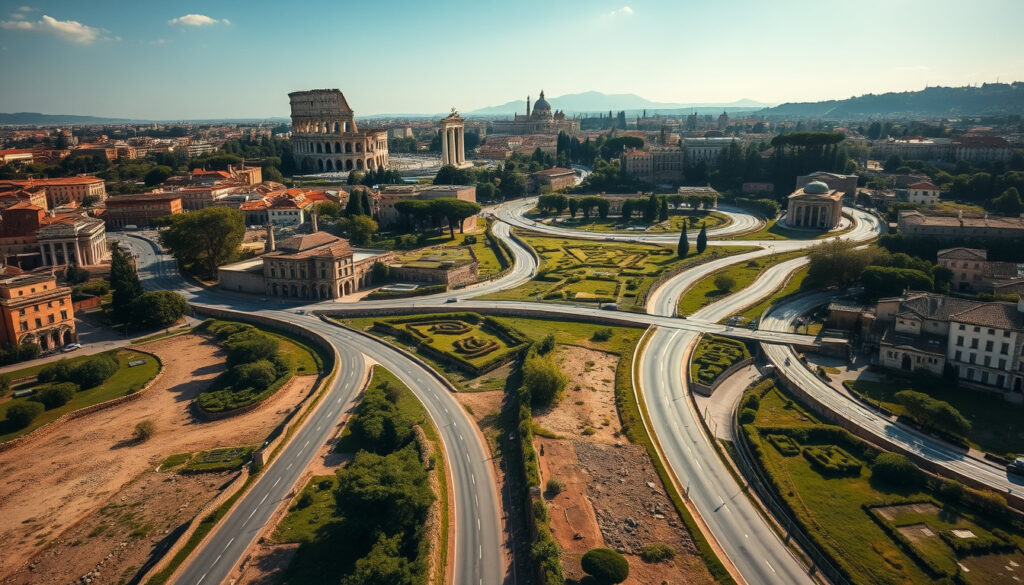
All Roads Lead to Rome: Meaning, Origin, and Modern Usage
Ever found yourself saying “all roads lead to Rome” without really knowing why? You’re not alone – the phrase was first recorded in 1175 by the theologian Alain de Lille.
First recorded use: 1175 by Alain de Lille ·
Roman road network length: over 400,000 km (250,000 miles) ·
Number of major roads converging on Rome: 29 (by the 4th century AD) ·
Modern dictionary inclusion: Cambridge English Dictionary (active) ·
Languages the proverb appears in: more than 50
Quick snapshot
- Figurative: many ways yield same outcome (Cambridge English Dictionary (language authority))
- Literal: Roman roads converge on Rome (Quodlibet Roma (historical travel blog))
- First recorded 1175 by Alain de Lille (University of Notre Dame, Italian Studies)
- Roman road network (29 major roads) (Quodlibet Roma (historical travel blog))
- Medieval Latin proverb “Mille viae ducunt hominem per saecula Romam” (University of Notre Dame, Italian Studies)
- Popularized in European languages from 12th century onward (University of Notre Dame, Italian Studies)
- Common in business, problem-solving, everyday speech (Grammarist (language reference))
- Italian equivalent “Tutte le strade portano a Roma” (Carpe Diem Tours (travel experience blog))
- Used in memes (e.g., rabbit meme) and song lyrics (Grammarist (language reference))
- Similar proverbs in many languages (see table below) (Carpe Diem Tours (travel experience blog))
- Catholic associations but not exclusively religious (Carpe Diem Tours (travel experience blog))
- Neutral or positive connotation in most contexts (Cambridge English Dictionary (language authority))
The snapshot above highlights five core facts about the proverb, from its first recorded use to its modern reach.
| Attribute | Value |
|---|---|
| First written record | 1175, Alain de Lille (University of Notre Dame, Italian Studies) |
| Length of Roman roads | Over 400,000 km (Carpe Diem Tours (travel experience blog)) |
| Number of main roads to Rome | 29 (Quodlibet Roma (historical travel blog)) |
| Modern dictionary inclusion | Cambridge English Dictionary (Cambridge English Dictionary (language authority)) |
| Languages with equivalent proverb | 50+ languages (Grammarist (language reference)) |
What does the idiom “All roads lead to Rome” mean?
Literal vs figurative meaning
- Literal sense: In ancient Rome, a network of roads physically radiated from the city. The Milliarium Aureum (Golden Milestone) was erected by Emperor Caesar Augustus in the central forum, and all distances in the empire were measured from that point (University of Notre Dame, Italian Studies). However, some sources caution that it’s not certain distances were measured from the monument itself.
- Figurative meaning: The proverb expresses that many different methods or paths can lead to the same outcome. The Cambridge English Dictionary defines it as “said to mean that all the methods of doing something will achieve the same result in the end.”
Common modern usage examples
- In business, teams often use it to acknowledge that multiple strategies can achieve a target.
- In everyday conversation, it’s a shorthand for flexibility: “We can take the train, drive, or fly – all roads lead to Rome.”
- The phrase appears in song titles (e.g., the 2013 hit by The Green) and pop culture references.
The implication: the proverb’s flexibility is its strength – it works equally well as a literal observation and a universal metaphor.
Is the saying “all roads lead to Rome” negative?
Neutral or negative connotations
- In standard English usage the phrase is neutral-to-positive, emphasizing convergence and multiple solutions (Grammarist (language reference)).
- Some people use it sarcastically to imply that no matter what you do, you’ll end up in the same bureaucratic or centralized system. For example, “I tried three different government offices, but all roads lead to Rome.”
- No lexicographic source marks it as inherently negative; the connotation depends on context.
The catch: the sarcastic tone only works if the audience recognizes the original positive meaning – it’s a twist, not the default.
Do Italians say “All roads lead to Rome”?
Italian version of the proverb
- Italians commonly say “Tutte le strade portano a Roma” – a direct translation that is both a proverb and a literal statement about the country’s road network (Carpe Diem Tours (travel experience blog)).
- The saying appears in Italian media, daily conversation, and even on road signs.
- It carries the same meaning as the English version, though Italians may use it more often in a literal geographical sense because Rome remains the country’s capital and a major hub.
What this means: the proverb feels native to Italian speakers, not borrowed – it’s rooted in the same Roman infrastructure that inspired the original Latin version.
Is “all roads lead to Rome” a Catholic saying?
Religious associations
- The phrase predates Christianity by centuries, but medieval Catholic scholars (including Alain de Lille) used it extensively (University of Notre Dame, Italian Studies).
- Rome’s role as the seat of the Catholic Church gave the saying a religious veneer, especially during the Middle Ages when pilgrims travelled to Rome from all over Europe.
- Today it is a secular proverb with historical ecclesiastical usage; no major dictionary classifies it as a religious term.
The trade-off: the Catholic association adds historical depth but doesn’t restrict the phrase’s modern, secular use.
What is the origin of the phrase “All roads lead to Rome”?
First written record
- The earliest known written version comes from the medieval Latin poem Liber Parabolarum by Alain de Lille (c. 1128–1202), a French theologian and poet. The line reads: “Mille viae ducunt hominem per saecula Romam” – “A thousand roads lead men through the ages to Rome” (University of Notre Dame, Italian Studies).
- Geoffrey Chaucer used a similar expression in his 1391 Treatise on the Astrolabe: “right as diverse pathes leden diverse folk the righte wey to Rome” (University of Notre Dame, Italian Studies).
Roman road network
- The Roman Empire built a vast road network that at its peak stretched more than 250,000 miles (over 400,000 km) (Carpe Diem Tours (travel experience blog)).
- By the 4th century AD, 29 major roads converged on Rome from across the empire (Quodlibet Roma (historical travel blog)).
- The road design on the Italian Peninsula followed a hub-and-spoke pattern, while in more distant provinces roads were more grid-like (BookBrowse (literary reference site)).
Medieval Latin context
- The proverb spread across Europe during the Middle Ages as Latin was the common language of scholarship and the Church.
- It appears in French, German, Spanish, and other vernacular languages by the 16th–19th centuries.
- In the 20th century it became a standard English idiom, listed in major dictionaries.
The pattern: each layer of history – Roman engineering, medieval scholarship, and global travel – added a new dimension to the saying.
Timeline: key milestones in the proverb’s journey
- 1st–4th century AD: Roman road network reaches its peak, with 29 roads converging on Rome (Quodlibet Roma (historical travel blog)).
- 1175: Alain de Lille writes “Mille viae ducunt hominem per saecula Romam” in Latin (University of Notre Dame, Italian Studies).
- 16th–19th centuries: Proverb spreads across Europe in vernacular languages.
- 20th century: “All roads lead to Rome” becomes a standard English idiom (Cambridge English Dictionary (language authority)).
- 2010s–present: The phrase gains new life in internet memes, including the “rabbit” maze meme.
Why this matters: the timeline shows that a saying born in antiquity can keep reinventing itself in new media.
The Roman road network is the literal foundation of a saying that now exists independently of its original context. Without those carefully engineered roads, there would be no memorable metaphor for convergence.
The rabbit meme is a playful modern twist on the ancient proverb, showing that the saying can adapt to visual culture.
What’s confirmed and what’s unclear
Confirmed facts
- First written attestation in 1175 by Alain de Lille (University of Notre Dame, Italian Studies).
- Roman road network had 29 major roads radiating from Rome (Quodlibet Roma (historical travel blog)).
- Proverb is listed in Cambridge English Dictionary as an idiom (Cambridge English Dictionary (language authority)).
- Chaucer used a similar phrase in 1391 (University of Notre Dame, Italian Studies).
What’s unclear
- Exact date the phrase entered everyday spoken English is unknown.
- Whether the proverb was used in classical Latin or only medieval Latin is disputed (BookBrowse (literary reference site)).
- The precise origin of the “rabbit” meme variation is not documented.
The confirmed facts outweigh the unclear ones, and the core historical narrative is well-established.
Expert voices on the phrase
“Mille viae ducunt hominem per saecula Romam.”
– Alain de Lille, 12th-century theologian, as recorded by University of Notre Dame, Italian Studies
“All roads lead to Rome is said to mean that all the methods of doing something will achieve the same result in the end.”
– Cambridge English Dictionary (language authority)
“Tutte le strade portano a Roma – Italians use it both as a proverb and a literal fact.”
– Commonly heard in Italy, cited by Carpe Diem Tours (travel experience blog)
From a 12th-century Latin poem to a 21st-century meme, “All roads lead to Rome” has shown an extraordinary ability to adapt. The lesson for today’s readers: the proverb remains relevant because it captures a fundamental human insight – that different routes can lead to the same destination. For anyone navigating a complex decision, the phrase is a quiet reminder to keep perspective: the path matters less than the goal.
For those curious about the idiom’s history, a comprehensive article on all roads lead to Rome meaning and origin explains its evolution from Latin origins to modern usage.
Frequently asked questions
What is the Latin original of “All roads lead to Rome”?
The original Latin phrase is “Mille viae ducunt hominem per saecula Romam,” written by Alain de Lille in 1175 (University of Notre Dame, Italian Studies).
How many Roman roads were there?
At the empire’s peak, 29 major roads converged on Rome, part of a network that stretched over 400,000 km (Quodlibet Roma (historical travel blog)).
Is “All roads lead to Rome” used in other languages?
Yes, the proverb appears in more than 50 languages, often as a direct translation of the English or Latin version (Grammarist (language reference)).
What is the “all roads lead to Rome” rabbit meme?
It’s a visual meme showing a maze on a rabbit’s fur that always leads to the center – a playful twist on the saying. The exact origin is unclear and not formally documented.
Can the phrase be used in a negative way?
Yes, but only ironically – for example, to complain that all bureaucratic paths lead to the same dead end. The standard connotation is neutral or positive (Grammarist (language reference)).
Who first said “All roads lead to Rome”?
The phrase is attributed to Alain de Lille, a 12th-century French theologian, who wrote it in Latin. Geoffrey Chaucer popularized it in English a few centuries later (University of Notre Dame, Italian Studies).
Does the proverb appear in popular music?
Yes – examples include the song “All Roads Lead to Rome” by The Green (2013) and references in other artists’ work.
Related reading
- Ad Astra Per Aspera: Meaning, Origin & Pop Culture – another Latin phrase that evolved similarly.
- What Caused the Great Depression: Key Factors Explained – exploring historical cause-and-effect patterns.
These related articles explore similar themes of historical phrases and cause-effect patterns.
More related posts
 Great British Baking Show 2026: Season 17, Format & Cast News
 Community First Credit Union: Weaknesses, Safety, and How It Compares
 Love Island Season 7 Reunion: Release Date, Watch Online on Peacock
 Film Developing Near Me in Dublin: Labs, Prices & Services
 Nike Zoom Fly 6 Review: Marathon Specs & Legality Check
 The Art of Racing in the Rain: Book vs. Movie & Controversy
 Best All Inclusive Resorts in Mexico 2026: Top Picks
 Upholstery Cleaning Near Me: Costs, Worth It & Ireland Services