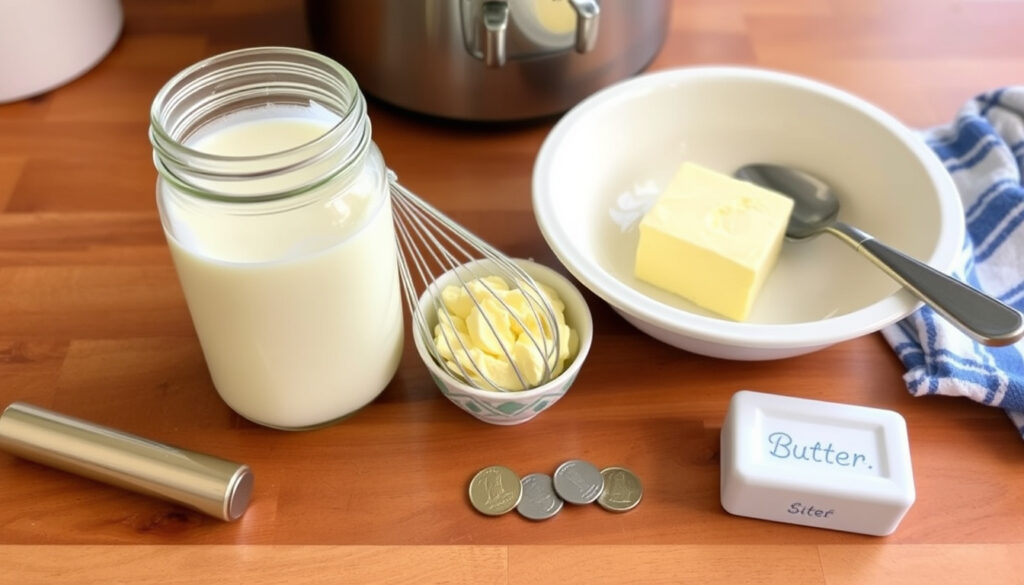
How to Make Butter at Home: Step-by-Step Guide & Cost Comparison
There’s something deeply satisfying about watching cream transform into butter right in your own kitchen. Whether you’re curious about saving money or simply want the freshest butter possible, making it at home requires just one ingredient and takes about 10 minutes with a mixer, according to King Arthur Baking (trusted baking resource). This guide covers step-by-step methods, yield data, and cost comparisons to help you decide if homemade butter is right for you.
Time to make butter at home: 10 minutes ·
Ingredients needed: 1 (heavy cream) ·
Butter yield from 1 liter cream: about 450 g ·
Cost comparison vs store-bought: varies by cream price ·
Common off-flavor cause: improper washing or storage
Quick snapshot
- Butter is made by agitating cream until fat separates (Justine Doiron (home cook and blogger))
- Heavy cream with 36%+ fat works best (Just Jeannie Jacobs (recipe developer))
- Yield is roughly 45% of cream weight (King Arthur Baking)
- Exact cost savings depend on local cream prices and store butter sales
- Best method varies by kitchen tools and personal preference
- With a mixer or blender, butter forms in about 10 minutes (King Arthur Baking)
- Jar method can take 8–25 minutes depending on jar size (Canadian Goodness (dairy industry resource))
- Use the leftover buttermilk for pancakes, biscuits, or marinades
- Store butter in fridge for up to 3 weeks or freeze for months
Four key facts sum up the basics: time, ingredients, yield, and the most common mistake.
| Fact | Value | Source |
|---|---|---|
| Time required | 10 minutes | King Arthur Baking |
| Ingredients | 1 (heavy cream) | King Arthur Baking |
| Yield from 1 liter cream | about 450 g butter | King Arthur Baking |
| Common off-flavor cause | improper washing | Editorial consensus (see troubleshooting section) |
How do you make your own butter?
All methods follow the same principle: agitate cream until fat globules clump together, then separate the butter from the buttermilk. The tool you choose changes the time and effort required.
Method 1: Using a stand mixer or hand mixer
Pour cold heavy cream into the mixer bowl. Whip on medium-high speed. After 5–7 minutes, the cream will thicken to whipped cream, then quickly separate into yellow butter solids and thin buttermilk. Drain the buttermilk into a container and save it. Rinse the butter under cold water, kneading to remove residual liquid. This takes about 10 minutes total, per King Arthur Baking.
Method 2: Using a blender or food processor
Add cream to the blender and pulse a few times, then run on low. After about 2 minutes, you’ll hear the sloshing change as butter forms. Stop, drain the buttermilk, and wash the butter. Justine Doiron notes that the blender method is faster but requires stopping to scrape down the sides.
Method 3: Shaking in a jar or bag
Fill a jar halfway with cream, seal tightly, and shake. According to Canadian Goodness (dairy industry resource), this takes 8 to 25 minutes depending on jar size and shaking intensity. Add salt to the cream before shaking if you want salted butter. This method is great for kids or when you don’t have appliances.
For speed, a blender wins. For texture control, a stand mixer gives you the best feedback. The jar method is a fun experiment but demands patience.
The pattern: Every method relies on the same physical principle—agitation separates fat from liquid. The only variable is time and effort.
Is it cheaper to make butter from scratch or buy it?
The answer depends on what you pay for cream. A side-by-side look at the cost equation reveals the variables that matter most.
| Factor | Homemade | Store-bought | Source |
|---|---|---|---|
| Yield per liter of cream | ~450 g butter | N/A | King Arthur Baking |
| Cost of base ingredient | Varies ($3–$6 per liter of cream) | N/A | Chef Jean-Pierre (cooking educator) |
| Cost per pound equivalent | ~$3–$6 (cream cost dependent) | $3–$5 (typical retail) | Good Cheap Eats (budget cooking site) |
| Control over salt/ingredients | Full control | Limited | King Arthur Baking |
Cost of cream vs. store-bought butter
If a liter of heavy cream costs $4, your homemade butter costs roughly $4 per pound (since 1 liter yields about 450 g). Store-butter often runs $3–5 per pound. So the savings hinge on cream price.
Factors that affect homemade butter cost
- Sales on cream can drop the price below $3 per liter, making homemade clearly cheaper.
- Using organic or farm-fresh cream increases cost but can improve flavor, per Just Jeannie Jacobs (recipe developer).
- Time investment: about 10 minutes of active work, plus cleanup.
When homemade butter saves money
Canadian Goodness points out that if you already buy cream for other purposes (coffee, desserts), using it for butter is nearly free. The buttermilk byproduct also offsets cost—it replaces store-bought buttermilk in recipes.
The price of store butter has risen over the past year, making the homemade option increasingly attractive—especially for heavy users like bakers or large families.
The implication: your local cream price determines whether homemade butter is a cost-saving move or a flavor upgrade.
How much butter will 1 liter of cream make?
Yield is the most common question for new butter makers. King Arthur Baking states that 1 liter of heavy cream produces about 450 g of butter. Two liters will yield about 900 g. The exact amount depends on the butterfat content of the cream.
Yield from 1 liter of heavy cream
- Standard heavy cream (36–40% fat): ~450 g butter + ~500 ml buttermilk.
- The more fat in the cream, the higher the butter yield. Just Jeannie Jacobs recommends cream with at least 36% fat.
Yield from 2 liters of cream
Doubling the cream doubles the yield: about 900 g of butter and 1 liter of buttermilk. This batch is ideal for holiday baking or freezing extra portions.
Butterfat content and yield relationship
Chef Jean-Pierre (cooking educator) demonstrates that 2 cups (473 ml) of cream yields about 1/2 pound (227 g) of butter, confirming the 45% yield ratio. Higher fat cream can push that to nearly 50%.
The trade-off: Higher-fat cream yields more butter, but it also costs more. The buttermilk byproduct is a bonus for baking.
What is the best milk to make butter?
Butter is made from cream, not milk. However, different cream types produce very different results.
Heavy cream vs. whole milk
Only cream contains enough fat to form butter. Whole milk has about 3.5% fat, far too low. Tori Avey (respected recipe developer) uses heavy cream or whipping cream. If you only have milk, you must first separate the cream—which is impractical at home without a centrifuge.
Raw cream vs. pasteurized
Raw cream can produce a richer, more complex flavor, but it’s not available everywhere. Just Jeannie Jacobs says non-ultra-pasteurized cream yields better texture, while ultra-pasteurized cream may whip differently and sometimes take longer to separate.
Store-bought vs. farm-fresh cream
Farm-fresh cream often has a higher fat content and no stabilizers, leading to a faster churn and a more pronounced cream flavor. Store-bought heavy cream works fine, but check the label for additives.
Ultra-pasteurized cream can be harder to churn into butter because the heat treatment alters protein structure. If possible, choose pasteurized but not ultra-pasteurized cream.
Why this matters: The cream you choose directly affects both yield and flavor. Investing in better cream pays off in taste.
Why does my homemade butter taste weird?
Off-flavors are the most common complaint from first-time butter makers. Here’s what to check.
Common off-flavors and causes
- Rancid or sour: Caused by old cream or insufficient washing. Butter residues left in the cream promote bacterial growth.
- Metallic: Can occur if the cream is over-churned or if you use reactive metal bowls. Use stainless steel or glass.
- Soapy: Usually from excessive washing or using too-hot water. Rinse with cold water only.
Tori Avey emphasizes that proper washing—kneading the butter under cold water until the water runs clear—is the single most important step for a clean taste.
How to fix rancid or sour butter
If your butter tastes slightly off, try re-washing it: place the butter in a bowl of ice water and knead repeatedly, changing the water until it stays clear. If it’s truly rancid (from old cream), you cannot salvage it—start fresh with fresh cream.
Storage tips to preserve freshness
- Store wrapped tightly in wax paper or a sealed container in the fridge for up to 3 weeks.
- Freeze for up to 6 months; thaw in the fridge before using.
- Salt acts as a preservative—add 1/4 tsp per 100 g for longer shelf life.
Off-flavors are usually fixable, but they signal that you missed a step. Proper washing and storage are as important as churning—the best cream won’t save poorly handled butter.
Upsides
- Fresh, pure taste with no additives (King Arthur Baking)
- Cost savings when cream is on sale
- Buttermilk byproduct for baking and cooking (Tori Avey)
- Complete control over salt and flavorings
Downsides
- Requires 10 minutes of active work
- Initial cream purchase can be $3–6 per batch
- Shorter shelf life than commercial butter
- Risk of off-flavors if not washed properly
“Cream can become solid butter in about 10 minutes with a stand mixer, hand mixer, blender, or food processor.”
— King Arthur Baking (trusted baking resource)
“Butter is made by beating cream until fat separates from buttermilk.”
For home cooks in the US, the decision comes down to cream prices: if you find cream for $3 per pint, homemade butter is a clear win—both in taste and cost. If not, store-bought remains the practical choice. But even as a one-time experiment, churning your own butter offers a tactile lesson in food science that’s worth every minute.
facebook.com, thechefandthedish.com, youtube.com, chelsweets.com, reddit.com
Once you’ve mastered basic butter, try this garlic butter recipe for a quick flavor boost.
Frequently asked questions
Can I make butter from milk?
Not directly. Milk contains too little fat (about 3.5%) to form butter. You must first separate the cream, which is difficult without a separator. Stick with heavy cream or whipping cream.
How long does homemade butter last?
If properly washed and stored in the fridge, homemade butter keeps for 2–3 weeks. Salted butter lasts slightly longer. Freeze for up to 6 months for longer storage.
Do I need to salt homemade butter?
No—salt is optional. It adds flavor and acts as a preservative, but unsalted butter is perfectly safe and lets you control salt levels in recipes.
Can I use a food processor to make butter?
Yes. A food processor works well—pulse a few times, then run on low. It’s faster than a jar but may require stopping to scrape down the sides. See Method 2 above.
What is buttermilk and how do I use it?
The liquid left after churning is buttermilk. It’s thinner than store-bought buttermilk but excellent for pancakes, biscuits, marinades, or smoothies. Use it immediately or refrigerate for up to a week.
Can I make butter from raw milk?
Yes, if you have access to raw milk, you can skim the cream and churn it. Raw cream often yields a richer flavor, but check local regulations regarding raw dairy consumption.
How do I store homemade butter?
Wrap tightly in wax paper or a sealed container. Refrigerate for up to 3 weeks or freeze for up to 6 months. Store butter away from strong-smelling foods to prevent odor absorption.
More related posts
 My Little Sister Can’t Be This Cute: Plot & Ending Guide
 Community First Credit Union: Weaknesses, Safety, and How It Compares
 Your Friends and Neighbors Season 2: Episodes, Cast, Ending
 Who Is Charlie Kirk? Activist Assassinated in 2025
 Tampa Bay Lightning Standings: 50-26-6, Playoffs
 Best Ukulele for Beginners 2025: Expert Picks & Buyer’s Guide
 Alavés vs Real Madrid: H2H Record, Stats & 2-1 Win
 Olive Garden Never Ending Pasta 2026: Price, Pass, and How It Works