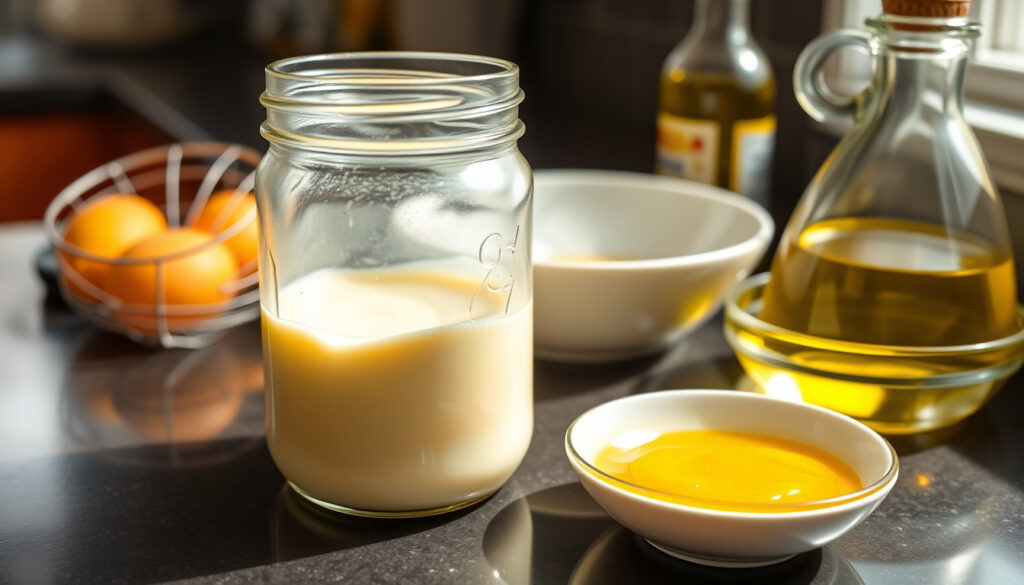
How to Make Mayonnaise: Simple Steps & Fixes
If you’ve ever watched a dollop of store-bought mayo and wondered why it tastes so flat, you’re not alone — homemade mayonnaise is richer, tangier, and endlessly adjustable, yet most people never try it because they’re afraid of raw eggs. This guide walks you through the classic emulsion technique, the science behind why it works, and exactly how to fix a batch that splits, so by the end you’ll be making mayonnaise that’s safer than anything from a jar.
Core Ingredients: Egg yolks, oil, acid, salt ·
Classic Oil-to-Yolk Ratio: 1 cup oil per 1 large yolk ·
Typical Emulsification Time (hand whisk): 3–5 minutes ·
Shelf Life (refrigerated): Up to 1 week ·
Minimum Temperature for Pasteurized Egg Safety: 140°F (60°C) for 3.5 minutes
Quick Snapshot
- Oil addition speed directly affects emulsion stability (Serious Eats, cooking science publication)
- Room-temperature yolks emulsify more easily than cold (Serious Eats)
- Pasteurized yolks eliminate salmonella risk at 140°F for 3.5 minutes (Cook’s Illustrated, America’s Test Kitchen)
- Optimal oil-to-yolk ratio for different oil types (e.g., olive vs. canola) is not universally agreed upon (Food Network)
- Long-term storage guidelines vary by source (Food Network says 4 days pasteurized, 1 day unpasteurized; Cook’s Illustrated suggests up to 1 month with abundant lemon juice)
- Pasteurization temperature recommendations vary: SafeConsume suggests 140°F for 3.5 minutes, while Cook’s Illustrated recommends 160°F (SafeConsume, Cook’s Illustrated) (Food Network)
- Homemade mayo with pasteurized eggs: up to 4 days refrigerated (Food Network)
- Homemade mayo with unpasteurized eggs: 1 day refrigerated (Food Network)
- Acidified yolk mixture (pH 3.9) can be held at room temperature for 2 hours before emulsifying (SafeConsume, food safety initiative)
- Try the 3-ingredient mayonnaise recipe (yolk, oil, acid) (How to Make Butter at Home)
- Experiment with flavored oils or add-ins like garlic or herbs (How to Make Butter at Home)
- Explore egg-free alternatives using aquafaba or silken tofu (How to Make Butter at Home)
- Try making your own butter at home – it’s another simple emulsified staple. (How to Make Butter at Home)
Four key facts, one pattern: the difference between a silky mayo and a greasy mess comes down to temperature, speed, and acid.
| Fact | Detail |
|---|---|
| Traditional French Mayonnaise Origin | 18th-century France, likely from Port Mahon |
| U.S. Commercial Mayonnaise Must Have | At least 65% vegetable oil by weight (FDA standard) |
| Oil Quantity for Single-Yolk Batch | Approximately 1 cup (240 ml) |
| Typical Calories per Tablespoon | 90–100 calories |
What are the ingredients used for mayonnaise?
Essential base: oil, egg yolks, acid
- Oil: Neutral oils like canola, grapeseed, or a light olive oil work best. Avoid extra-virgin olive oil unless you want a bitter, grassy flavor. The classic ratio is about 1 cup (240 ml) of oil per large egg yolk (Food Network). For more on canola oil, see our article on whether canola oil is banned in Europe. (Is Canola Oil Banned in Europe? The Truth Behind the Myth)
- Egg yolks: Room-temperature yolks emulsify more reliably than cold ones. You can use pasteurized eggs to eliminate salmonella risk — heat the yolks to at least 140°F (60°C) for 3.5 minutes, or use pre-pasteurized liquid yolks (Cook’s Illustrated).
- Acid: Lemon juice or vinegar (white wine, apple cider, or champagne) provides tang and helps stabilize the emulsion. Some recipes also add Dijon mustard, sugar, or salt for depth.
Optional flavor: mustard, salt, sugar
A teaspoon of Dijon mustard acts as an emulsifier and adds a gentle heat. A pinch of salt and a half-teaspoon of sugar round out flavors without making the mayo sweet. These additions are flexible — adjust to your taste.
Getting the base right determines whether your mayo sets or separates. The emulsion depends on fat droplets being small enough to stay suspended — that’s why oil must be added slowly and yolk must be at the right temperature.
Bottom line: Three core ingredients (oil, yolk, acid) plus optional mustard and salt. Room-temperature yolks and a neutral oil give the most reliable start for beginners and pros alike.
How do I make homemade mayonnaise?
- Step 1: Gather and prep ingredients at room temperature
Take eggs out of the fridge 30 minutes before starting. Have your oil measured, acid measured, and a clean bowl ready. Room-temperature ingredients emulsify faster and are less likely to break (Serious Eats).
- Step 2: Whisk yolks and acid together
In a medium bowl, whisk 1 large egg yolk with 1 tablespoon of lemon juice or vinegar (or a combination) until pale and slightly thickened. Add a pinch of salt and mustard if using. Whisk for about 30 seconds to incorporate air.
- Step 3: Emulsify by adding oil slowly
While whisking constantly — or with a blender on low — add oil drop by drop for the first 2 tablespoons. Once the mixture starts to thicken and look creamy, you can stream the remaining oil in a slow, steady trickle. This process takes 3–5 minutes by hand, under 2 minutes with an immersion blender (Serious Eats).
- Step 4: Season and adjust
Once all oil is incorporated and the mayo is thick enough to hold a ribbon on the whisk, stir in additional lemon juice, salt, or pepper to taste. Transfer to an airtight container and refrigerate immediately.
Hand whisking gives you more control and a slightly thicker texture. An immersion blender (the “fastest way,” according to Serious Eats) is nearly foolproof — just place all ingredients except oil in a tall jar, then slowly drizzle oil while blending from the bottom.
Bottom line: Room-temperature yolks, drop-by-drop oil at the start, and constant stirring. Blender method: 60 seconds. Hand whisk: 5 minutes. Both work if you respect the emulsion.
What are common mistakes when making mayonnaise?
Broken emulsion: added oil too fast
Pouring oil in a steady stream too early overwhelms the emulsifier (lecithin in the yolk). The mixture suddenly thins and oil slicks appear on the surface. This is fixable (see next section).
Runny mayo: ratio off or over-whisking
If your mayo is thin and doesn’t thicken, either you didn’t use enough oil (aim for a full cup per yolk) or the emulsion broke because of overheating from whisking too aggressively. Runny mayo can also happen if the acid level is too high — stick to 1–2 tablespoons per yolk.
Bitterness from olive oil
Extra-virgin olive oil contains polyphenols that make mayo taste harsh. Use a mild olive oil (light or “olive oil” blend) or a neutral oil like canola, grapeseed, or avocado (Serious Eats).
A single broken batch can be fixed with a new yolk — but over-whisking or using too much acid can’t be reversed. Start with a standard ratio (1 yolk : 1 cup oil : 1 tbsp acid) until you’re comfortable.
Bottom line: Home cooks: most mistakes stem from speed (oil added too fast) or ratio (not enough oil). Both are fixable; bitterness from olive oil is a flavor choice, not a technique error.
Broken or Runny Mayonnaise: How to Fix it?
Fixing split emulsion by whisking into a fresh yolk
Place 1 fresh egg yolk and 1 teaspoon of cold water in a clean bowl. Carefully and slowly whisk 1 tablespoon of the broken mayonnaise into the new yolk. As it re-emulsifies and thickens, gradually add the rest of the broken mixture, faster but still in a thin stream (Danielle Walker, recipe developer).
Fixing runny mayo by adding more oil
If your mayo is thin and not broken (no visible oil separation), place it back in a bowl and slowly whisk in more oil — another 1/4 to 1/2 cup — drop by drop until it reaches the desired thickness. This works because the emulsion still exists but was under-fat.
Don’t try to fix a broken emulsion by adding more liquid acid — that will make it worse. Always use a new yolk as the anchor. A runny but unbroken mayo is simply under-oiled; add oil gradually while whisking.
Bottom line: If your mayo splits, start with a fresh yolk and water; if it’s runny, add more oil. Both rescue methods have high success rates when done correctly.
Is homemade mayonnaise safe? Why is it sometimes not advisable?
Risk of salmonella from raw eggs
The primary concern with homemade mayonnaise is salmonella from raw eggs. The FDA estimates about 1 in 20,000 eggs in the U.S. might be contaminated. For healthy adults the risk is low, but for pregnant people, young children, older adults, and immunocompromised individuals it’s real (SafeConsume food safety initiative).
Pasteurized yolks eliminate risk
The USDA recommends heating yolks to 140°F (60°C) for 3.5 minutes to kill salmonella — this can be done by gently warming the yolk with a little liquid before emulsifying. Cook’s Illustrated specifies heating the yolk mixture to at least 160°F using a double boiler or microwave (Cook’s Illustrated). Pre-pasteurized eggs sold in cartons are another safe shortcut.
Proper refrigeration prolongs safety
Homemade mayonnaise must be refrigerated at all times below 40°F (4°C). Food Network advises that mayo made with pasteurized eggs keeps up to 4 days; with unpasteurized eggs, discard after 1 day (Food Network). SafeConsume notes that acidifying the yolk to pH 3.9 before adding oil can delay bacterial growth for same-day use, but commercial pasteurization is the most reliable approach.
Using pasteurized eggs adds a step but removes the anxiety entirely for at-risk groups. For healthy adults, fresh eggs from a trusted source and proper refrigeration keep risk negligible. The choice is between convenience and absolute safety.
Bottom line: Homemade mayo is safe with pasteurized eggs or proper heat treatment. Food safety authorities: pasteurize at 140°F/3.5 min. Shelf life: 4 days (pasteurized), 1 day (unpasteurized).
“The fastest way to make perfect mayo every time is with an immersion blender.”
— J. Kenji López-Alt, Serious Eats
“Heating egg yolks to 160°F kills common pathogens — a simple step that makes homemade mayo safe for everyone.”
For home cooks in the U.S. and Europe, the choice between store-bought and homemade mayonnaise is clear: invest 5 minutes in pasteurization and you get a fresher, safer product than anything in a jar. Skip the precaution and you’re gambling with a 1:20,000 odds — a risk most healthy adults are fine with, but not one to ignore if you’re serving vulnerable guests.
youtube.com, cedarswamphomestead.medium.com, orangegroveroad.com, reddit.com
Frequently Asked Questions
Can I use olive oil instead of vegetable oil for mayonnaise?
Yes, but use a light or mild olive oil. Extra-virgin olive oil will make your mayo taste bitter and grassy. For the best balance, blend 3 parts neutral oil (canola, grapeseed) with 1 part flavorful oil like extra-virgin.
How long does homemade mayonnaise last in the refrigerator?
With pasteurized eggs: up to 4 days (Food Network). With unpasteurized eggs: discard after 1 day. Some sources (Cook’s Illustrated) say up to 1 month if the mixture is very acidic (ph < 3.9), but that's riskier. Stick to 4 days for safety.
Can I freeze homemade mayonnaise?
Freezing is not recommended. The emulsion breaks upon thawing, leaving a curdled, watery mess. If you need to store longer, make a smaller batch or use pasteurized eggs and refrigerate for up to a week.
What is the best oil for mayonnaise to avoid bitterness?
Neutral oils like canola, grapeseed, sunflower, or avocado. If you want olive oil flavor, use a light or “olive oil” blend — never extra-virgin alone.
Is it safe to eat homemade mayonnaise during pregnancy?
Only if made with pasteurized eggs or heat-treated yolks (140°F for 3.5 minutes). The CDC and USDA recommend pasteurized eggs for pregnant individuals to avoid salmonella risk.
How do I make mayonnaise without a blender or whisk?
You can use a fork and a bowl, but it takes 10–15 minutes of steady stirring. A Mason jar with a tight lid also works: add ingredients, shake vigorously for 2 minutes, then slowly stream in oil while shaking. The immersion blender method is much faster.
Can I use a whole egg instead of just egg yolks?
Yes, whole-egg mayonnaise exists. Use 1 whole egg (or 2 for a larger batch) and reduce the liquid slightly. The white adds water, so the mayo may be slightly thinner. Still requires the same slow oil addition.
More related posts
 USAA Data Breach Settlement: Eligibility and Payout
 Olive Garden Near Me – Locations, Hours & Delivery Guide
 Bent Over Barbell Row: Muscles Worked, Form, and Common Mistakes
 Sean Combs Net Worth 2025: $800M Drop & Billionaire Decline
 SAT Test Dates 2025: Schedule, Deadlines & Score Benchmarks
 Rolex GMT-Master II: Price, Value & Worth for 2025
 Die With a Smile Lyrics: Full Text and Song Meaning
 Patio Furniture Near Me: Best Month & Durable Materials Guide