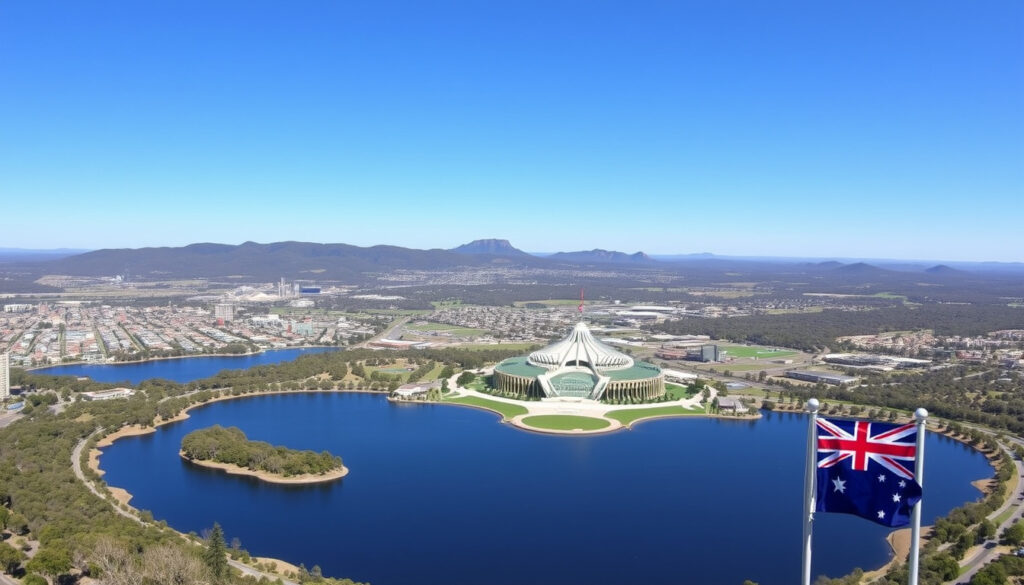
What is the Capital of Australia? Canberra Facts & History
You’ve probably been asked “What is the capital of Australia?” more than once. The answer is Canberra — but the story behind that answer is a fascinating tale of political compromise, rivalries, and a purpose-built city.
Official capital: Canberra · Population of Canberra (2021): 484,630 · Year named capital: 1913 · Federal territory: Australian Capital Territory · Distance from Sydney: 280 km southwest · Previous capital (1901–1927): Melbourne
Quick snapshot
- Canberra is the capital of Australia (Wikipedia)
- Canberra lies in the Australian Capital Territory (Encyclopaedia Britannica)
- Melbourne served as interim capital from 1901 to 1927 (National Capital Authority)
- Some people mistakenly believe Sydney is the capital due to its prominence (Australian Geographic)
- 1908: Parliament selected Yass-Canberra as the capital site (Australian Bureau of Statistics)
- 1927: Federal parliament moved from Melbourne to Canberra (Parliament of Australia Education Office)
- Canberra continues to develop as a planned city under the National Capital Authority (Australian Politics and Policy)
The table below summarizes the key facts about Australia’s capital.
| Fact | Details |
|---|---|
| Official capital | Canberra |
| Previous capital (1901–1927) | Melbourne |
| Largest city | Sydney |
| National capital territory | Australian Capital Territory (ACT) |
| Year federal parliament moved | 1927 |
What is the capital of Australia?
What is the official capital of Australia?
The official capital city of Australia is Canberra, located in the Australian Capital Territory (ACT). According to Wikipedia, Canberra is the federal capital of the Commonwealth of Australia. It was purpose-built as a planned city and is situated about 240 km southwest of Sydney, as noted by Encyclopaedia Britannica.
- Canberra is the largest population centre in the ACT (Wikipedia).
- It is Australia’s largest inland city (Wikipedia).
- Approximately 80% of Australians live in eastern coastal states, not in Canberra itself (Australian Bureau of Statistics).
The implication: Canberra’s role is political and administrative, not commercial — the country’s economic hubs remain Sydney and Melbourne.
The pattern: Canberra is a political capital, not a commercial one.
Why is Sydney no longer the capital of Australia?
Is Sydney a capital of Australia?
No. Sydney is the capital of the state of New South Wales, but it has never been the national capital. According to the National Capital Authority, the Australian Constitution deliberately left the location of the federal capital open to resolve the rivalry between Sydney and Melbourne.
Is Melbourne or Sydney the capital?
Neither. Melbourne served as the interim capital from Federation in 1901 until 1927, when the federal parliament moved to Canberra. The Parliament of Australia Education Office confirms that Melbourne was never the permanent capital; it was a temporary arrangement.
Is Perth the capital of Australia?
No. Perth is the capital of Western Australia. Like Sydney and Melbourne, it is a state capital, not the national capital.
- Melbourne was the interim capital (1901–1927) (National Capital Authority).
- Canberra was chosen as a compromise site in 1908 (Australian Bureau of Statistics).
The pattern: The Sydney-Melbourne rivalry is often overstated. Historian David Headon, quoted by Australian Geographic, called it “nonsense, just a perpet… myth.” The real driver was the need for a neutral site.
Most people outside Australia assume Sydney is the capital. That misconception persists because Sydney is the largest city and the most visited. For travellers, knowing the correct capital prevents embarrassing mistakes — and reveals a fascinating piece of federation history.
The implication: The compromise was not just about Sydney vs. Melbourne, but about creating a neutral federal seat.
Does Australia have two capitals?
No. Australia has one national capital: Canberra. However, each of the six states and the two internal territories has its own capital city. For example, Sydney is the capital of New South Wales, Melbourne is the capital of Victoria, and so on. The confusion may arise because Melbourne was the interim capital from 1901 to 1927, and because the federal parliament still occasionally meets in Melbourne (though rarely). The Encyclopaedia Britannica clearly states that Canberra is the sole national capital.
- State capitals: Sydney (NSW), Melbourne (Vic), Brisbane (Qld), Perth (WA), Adelaide (SA), Hobart (Tas).
- Territory capitals: Darwin (NT), Canberra (ACT — also national capital).
The catch: Although there is only one national capital, the federal system means each state capital holds significant political and economic power — making the federation more balanced than a unitary system.
Why is Canberra the capital of Australia?
What was the capital of Australia before Canberra?
Before Canberra, Melbourne was the temporary seat of government from 1 January 1901 until 1927. The National Capital Authority explains that the site for the permanent capital was chosen after a decade of debate. In October 1908, Parliament passed the Seat of Government Bill, fixing the Yass-Canberra region as the national capital site, according to the Australian Bureau of Statistics.
The land that became the Australian Capital Territory was transferred from New South Wales to the federal government on 1 January 1911 (Wikipedia). Canberra was officially named on 12 March 1913 at a ceremony where Lady Denman declared, “I name the capital of Australia, Canberra – the accent is on the Can” (National Capital Authority).
“I name the capital of Australia, Canberra – the accent is on the Can” — Lady Denman, 12 March 1913 (National Capital Authority)
The trade-off: By choosing a remote inland site, Australia gained a neutral political centre but created a capital with limited economic draw — a deliberate choice to avoid favouring either Sydney or Melbourne.
The pattern: The site was chosen for its neutrality, not solely because of rivalry.
When was Canberra made the capital of Australia?
The process unfolded over decades. Key dates:
- 1908 — Parliament selected the Yass-Canberra region as the capital site (Australian Bureau of Statistics).
- 1911 — The Australian Capital Territory was formally created (Parliament of Australia Education Office).
- 12 March 1913 — Official naming ceremony (National Capital Authority).
- 9 May 1927 — Federal parliament moved to the Provisional Parliament House (National Capital Authority).
- 1988 — The new Parliament House opened, cementing Canberra’s role (Parliament of Australia Education Office).
The pattern: Canberra’s journey from a sheep-grazing valley to a fully functional capital took nearly 80 years. It remains Australia’s only purpose-built capital city.
Timeline: Canberra becomes the capital
- 1 January 1901: Federation of Australia; Melbourne chosen as temporary seat of government.
- 1908: Canberra selected as the future capital site after a decade of debate.
- 12 March 1913: Official naming ceremony for Canberra.
- 9 May 1927: Federal parliament moves to Canberra; opening of Provisional Parliament House.
- 1988: New Parliament House opens, cementing Canberra’s role as permanent capital.
Sources for this timeline: National Capital Authority, Australian Bureau of Statistics, Parliament of Australia Education Office.
The implication: The timeline shows a deliberate, phased transition to a purpose-built capital.
Clarity: What’s confirmed and what’s not
Confirmed facts
- Canberra is the capital of Australia (Wikipedia).
- Melbourne served as interim capital from 1901 to 1927 (National Capital Authority).
- Canberra was chosen as a compromise between Sydney and Melbourne (Australian Bureau of Statistics).
Unclear / Myth
- Some people mistakenly believe Sydney is the capital due to its prominence — but Sydney was never the national capital.
- Some historians argue that the Sydney-Melbourne rivalry is an oversimplification (Australian Geographic).
- The idea that Canberra was chosen solely because of the rivalry is a myth (Australian Geographic).
The pattern: The historical record is clear, but popular misconceptions persist.
Expert perspectives
“The Sydney-Melbourne idea is nonsense, just a perpet… myth.”
— Historian David Headon, quoted by Australian Geographic
“I name the capital of Australia, Canberra – the accent is on the Can.”
— Lady Denman, at the naming ceremony, reported by National Capital Authority
These contrasting voices — a historian debunking the rivalry myth and a colonial figure formally christening the city — frame the debate. The rivalry myth persists, but the official record is clear: Canberra was a compromise, but not in the simplistic Sydney-vs-Melbourne terms often repeated.
Summary
Canberra is the capital of Australia — not Sydney, not Melbourne, and not Perth. It was purpose-built as a compromise capital, chosen to avoid favouring either of the two largest cities. For travellers and students of Australian history, the implication is clear: understanding why Canberra exists sheds light on the country’s federal structure and its deliberate effort to create a neutral political centre. For anyone visiting Australia, the practical takeaway is straightforward: book your flights to Canberra if your business is with the government — but for every other reason, you’ll probably land in Sydney or Melbourne first.
Many travelers are surprised to learn that Canberras history and founding reveals a city deliberately built as a compromise between Sydney and Melbourne.
Frequently asked questions
What is the difference between the capital city and a state capital?
The national capital (Canberra) is the seat of the federal government. State capitals are the administrative centres for each state — for example, Sydney for New South Wales, Melbourne for Victoria. Australia has one national capital and six state capitals plus two territory capitals.
Is Canberra the largest city in Australia?
No. Canberra is the eighth-largest city by population, with 484,630 residents (2021 census). Sydney is the largest, with over 5 million people.
How do you pronounce ‘Canberra’?
It’s pronounced “CAN-bruh” or “KAN-bər-ə” — the accent is on the first syllable. Lady Denman famously emphasized “the accent is on the Can” at the naming ceremony.
What is the Australian Capital Territory?
The ACT is a federal territory that contains Canberra. It was created in 1911 from land transferred from New South Wales. It is self-governing since 1989, but the National Capital Authority retains control over areas of national significance.
Can you visit Parliament House in Canberra?
Yes, Parliament House is open to the public. Guided tours are available, and visitors can watch parliamentary sessions when parliament is sitting. The building opened in 1988 and is a major tourist attraction.
Why is Canberra not a coastal city?
Canberra was deliberately built inland to be a neutral compromise between Sydney and Melbourne. The site was chosen for its mild climate, access to water, and distance from the coastal rivals.
What is the population of Canberra compared to Sydney and Melbourne?
Canberra’s population is approximately 484,630 (2021). Sydney’s is about 5.3 million and Melbourne’s about 5 million. Canberra is much smaller, reflecting its role as a political and administrative centre rather than a commercial hub.
More related posts
 Liver King Net Worth 2024: Brian Johnson Wealth Breakdown
 The Hate U Give: Book Bans, True Story, Streaming & Age Rating
 Rapid COVID Testing Near Me: Quick Tests in Ireland
 What Time Is Sunrise? Ireland Sunrise Times & Terminology
 Honda Dealer Near Me in Ireland: Best Time to Buy & Reliable Models
 New Balance 9060 Grey: Ireland Stock, Prices & Buy Guide
 AI Image Generator Free – Top No-Signup Tools 2025
 Olive Garden Near Me – Locations, Hours & Delivery Guide