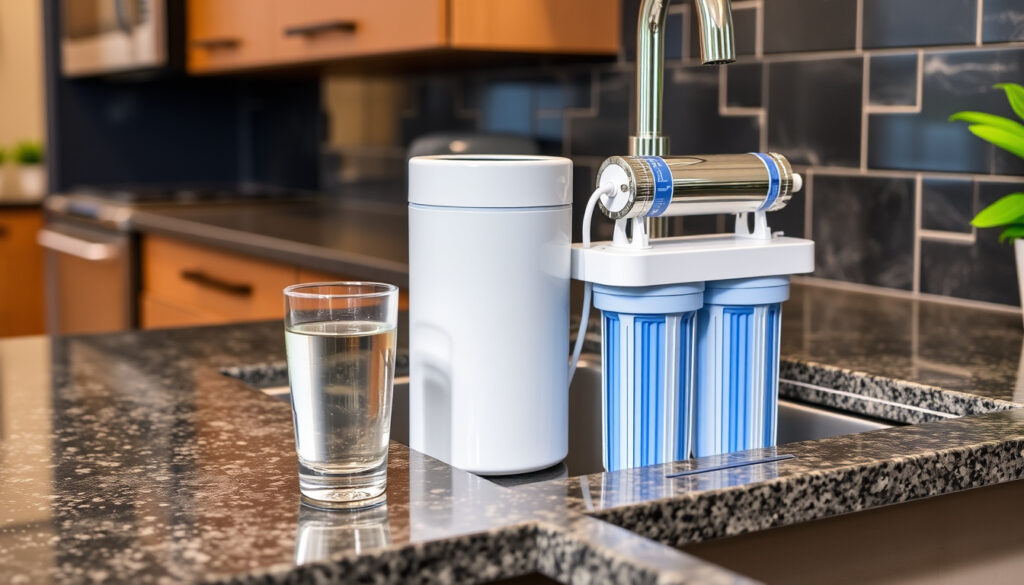
Reverse Osmosis System for Home: Cost, Downsides & Best Options
Anyone who’s ever filled a glass from the tap and wondered what’s actually in it knows the feeling. For Irish homeowners, that curiosity often leads to the same question: is a reverse osmosis system the right filter for their home, and this guide cuts through the sales talk to compare costs, health trade-offs, and what actually works for Irish water conditions.
Contaminant removal rate: 99.9% · Average waste water ratio: 3:1 to 4:1 · Typical system cost in Ireland: €200 – €500 · Common filter lifespan: 6–12 months · Reduction in TDS: up to 95%
Quick snapshot
- RO removes up to 99.9% of dissolved solids and pathogens (NSF International (global certification body))
- Under-sink systems in Ireland range from €200 to €500 (Water Filtration Ireland (Irish RO supplier))
- RO produces 3–4 gallons of waste water per gallon purified (US EPA (federal environmental agency))
- Long-term health effects of drinking demineralised water (World Health Organization (global health authority))
- Whether whole-house RO is cost-effective for typical Irish homes (HomePros Ireland (Irish home services platform))
- Optimal system for cryptosporidium removal under Irish tap water conditions (World Health Organization (global health authority))
- RO has been used in homes since the 1970s; recent innovations include direct-flow and tankless models (Water Filtration Ireland (Irish RO supplier))
- Irish water quality concerns (e.g., cryptosporidium outbreaks) have driven interest in RO (Uisce Éireann (Irish public water utility))
- Expect more tankless, remineralising RO systems entering the Irish market (myh2o.ie (Irish water filter retailer))
- Irish homeowners should test water hardness and check for specific contaminants before buying (Hot Water Taps Ireland (Irish water hardware specialist))
Five key specs define what a reverse osmosis system can do, and what trade-offs it brings.
| Specification | Value |
|---|---|
| Membrane pore size | 0.0001 microns |
| Typical flow rate (under-sink) | 2–4 gallons per day |
| Common certifications | NSF/ANSI 58, NSF/ANSI 53 |
| Water waste ratio | 1:3 to 1:4 (product to waste) |
| Filter stages | 3 to 6 (sediment, carbon, membrane, post-carbon, etc.) |
| Total dissolved solids (TDS) reduction | up to 95% |
| Contaminant removal rate | 99.9% |
The key takeaway: RO membranes are exceptionally fine, but that precision comes at a cost in water waste and flow rate.
Are whole house reverse osmosis systems worth it?
Installing a whole-house RO system means every tap delivers filtered water, not just the kitchen sink. But the convenience comes with significant costs and practical hurdles.
What are the benefits of whole house RO?
- Filtered water at every tap – showers, washing machines, garden hoses – protecting plumbing from scale and contaminants
- Removes contaminants like chlorine, lead, and pesticides from all water entering the home
- Ideal for areas with severe water contamination (e.g., high nitrates, heavy metals)
What are the drawbacks?
- High upfront cost: whole-house systems in Ireland typically range from €1,000 to €3,000, plus installation (HomePros Ireland (Irish home services platform))
- Requires a large storage tank and drainage, which may need structural modifications (Celtic Water Solutions (Irish water treatment company))
- May remove beneficial minerals like calcium and magnesium, potentially requiring mineral supplementation
- Higher waste water output – up to 4 gallons wasted per gallon produced
How does whole house RO compare to point-of-use systems?
Here’s a quick comparison of the two main approaches for Irish homes.
| Factor | Whole-house RO | Point-of-use (under-sink) RO |
|---|---|---|
| Coverage | All taps | Single tap (usually kitchen) |
| Installation cost (Ireland) | €1,000 – €3,000 | €200 – €500 (supplied & installed) |
| Annual filter cost | €200 – €400 | €100 – €200 |
| Water waste | Higher (3–4:1 ratio, larger volume) | Lower (3–4:1 ratio, smaller volume) |
| Mineral removal | Yes – affects all water | Yes – only drinking water |
| Space requirement | Large tank + dedicated area | Under-sink cabinet |
The trade-off: For most Irish homes, a point-of-use under-sink RO system offers the best value. It provides high-quality drinking water without the expense and complexity of whole-house filtration. Whole-house RO is only justified in areas with severe widespread contamination.
What is the downside of reverse osmosis?
RO is powerful, but it’s not a perfect solution. Three main drawbacks matter most to Irish homeowners.
Does RO waste water?
- Standard RO systems waste 3–4 gallons per gallon produced
- Newer direct-flow models reduce waste to 1:1, but cost more
- In metered water areas, this adds to the running cost
Yes. Standard RO systems produce 3 to 4 gallons of waste water for every gallon of purified water, according to US EPA (federal environmental agency) guidelines. Newer direct-flow models reduce this ratio to about 1:1, but they cost more. In Ireland, where water is metered in some areas, this waste adds to the running cost.
Does RO remove beneficial minerals?
- RO membranes remove calcium, magnesium, and trace minerals
- WHO notes demineralised water may not be ideal for long-term consumption
- Some systems add remineralisation stage
Yes. RO membranes remove calcium, magnesium, and other trace minerals. The World Health Organization (global health authority) notes that demineralised water may not be ideal for long-term consumption, especially for people with mineral deficiencies. Some systems add a remineralisation stage to address this.
Is RO water acidic?
- RO water pH typically 6.0–6.5
- Caused by CO2 dissolving after membrane
- Post-carbon filter can raise pH
RO water typically has a pH between 6.0 and 6.5, slightly acidic. This is because carbon dioxide dissolves into the water after the membrane. The World Health Organization states that drinking water with pH below 6.5 is not harmful but can be corrosive to pipes. A post-carbon filter can raise the pH slightly.
The catch: RO’s strength is also its weakness – it removes everything, including the good stuff. For most Irish homeowners, the key is to match the system to actual water quality, not to over-filter.
For every litre of purified water your RO system produces, it sends 3–4 litres down the drain. In a household drinking 2 litres per day, that’s 6–8 litres of waste – add up to 2,500 litres a year. In areas with water metering, this is a real cost.
How much does a reverse osmosis system cost in Ireland?
Pricing varies widely by brand, stage count, and whether installation is included. Here’s what Irish homeowners can expect.
What is the price range for under-sink RO systems?
- Basic systems: €169 – €250 (e.g., from AquaEuro (Irish water filter retailer) and Water Filtration Ireland)
- Mid-range systems: €300 – €500 (including installation) from Celtic Water Solutions and myh2o.ie
- Premium direct-flow/pumped systems: €500 – €900 (installed) from Water Filtration Ireland and HomePros Ireland
What are installation costs?
Installation by a plumber typically adds €100 – €200, according to HomePros Ireland. Some retailers bundle installation, so the total cost for a supplied-and-installed system is often €400 – €600.
How much do replacement filters cost annually?
Annual filter replacement costs range from €100 to €200, depending on the system. FKB (Irish water systems provider) estimates about €0.02 per litre of filtered water, which works out to roughly €150 per year for a typical household.
The pattern: The upfront cost is only half the story. Over five years, the total cost of ownership for an under-sink RO system in Ireland is roughly €1,000 – €1,500, including purchase, installation, and filters. That’s about €0.02 per litre – comparable to bottled water but far less than buying it.
Upsides
- Removes up to 99.9% of contaminants
- Improves taste and odour of water
- Reduces reliance on bottled water
- Certified systems protect against cryptosporidium
Downsides
- Waste water: 3–4 gallons per gallon purified
- Removes beneficial minerals
- Higher upfront cost than basic filters
- Requires regular filter changes
What is the best water filter for cryptosporidium?
Cryptosporidium is a parasite that can cause serious illness, and it’s a known concern in Irish water supplies. Here’s what works.
Does reverse osmosis remove cryptosporidium?
- RO systems with absolute 1 micron or smaller pores effectively remove cryptosporidium oocysts
- NSF/ANSI Standard 58 certifies cyst reduction
- Irish homeowners should look for this certification
Yes – RO systems with absolute 1 micron or smaller pores effectively remove cryptosporidium oocysts. The NSF International certifies systems under NSF/ANSI Standard 58 for cyst removal. Irish homeowners should look for this certification.
What other filters work for cryptosporidium?
- UV light systems: Destroy cryptosporidium DNA without removing it physically
- Distillation: Boils water and condenses steam, killing all pathogens
- Ceramic filters with pores ≤1 micron: Effective but require regular cleaning
Carbon filters alone do not remove cryptosporidium – they lack the pore size needed.
How to choose a cryptosporidium filter?
Check for NSF/ANSI Standard 53 or 58 certification for cyst removal. In Ireland, Uisce Éireann (Irish public water utility) provides local water quality data – if your area has had cryptosporidium outbreaks, a certified RO system or UV filter is recommended.
Why this matters: For Irish households in areas with a history of cryptosporidium, relying on carbon filtration alone is a health risk. A certified RO system or UV disinfection provides verified protection.
When shopping for a cryptosporidium filter, the only seal that matters is NSF/ANSI Standard 58 or 53 for cyst reduction. Without it, you’re trusting the manufacturer’s word – not a verified test.
Is there anything better than reverse osmosis?
RO is excellent for broad-spectrum removal, but other technologies may be better suited for specific contaminants or lower cost.
What are alternatives to RO?
- Activated carbon filters: Remove chlorine, taste, and odour, but not dissolved solids or microbes
- UV purification: Kills bacteria and viruses but does not remove chemicals or heavy metals
- Distillation: Removes nearly everything, but uses significant energy and produces water with a flat taste
- Multi-stage filtration (e.g., sediment + carbon + UV): Can match RO for many contaminants without the water waste
How does RO compare to distillation?
Both remove dissolved solids and pathogens. Distillation uses about 4–5 kWh per gallon, far more than RO. RO waste water is a concern, but distillation’s energy cost is higher. For most Irish homes, RO is more practical for daily drinking water.
Is activated carbon better than RO?
Not for removing dissolved solids, nitrates, or microbes. Activated carbon is excellent for chlorine and organic compounds, but it’s not a substitute for RO when water quality is poor. Many Irish homes use a combination: carbon pre-filter for taste, then RO for purity.
The trade-off: No single technology is “best” for everything. The right choice depends on your water’s specific contaminants. For general drinking water improvement, RO offers the widest protection. For targeted issues like chlorine taste, carbon is cheaper and sufficient.
Confirmed facts
- RO systems remove >99% of total dissolved solids and many pathogens
- RO produces waste water (3–4:1 ratio)
- Costs vary by brand and installation complexity
What’s unclear
- Long-term health effects of drinking demineralised water
- Whether whole-house RO is cost-effective for typical Irish homes
- Optimal system for cryptosporidium removal under Irish tap water conditions
“Irish tap water is generally safe, but localised issues like cryptosporidium outbreaks and high hardness can make additional filtration advisable.”
— Uisce Éireann (Irish Water) (Irish public water utility), official water quality statement
“NSF/ANSI Standard 58 certifies that a reverse osmosis system reduces at least 99.9% of total dissolved solids, including cysts like cryptosporidium.”
— NSF International (global certification body), certification standards
“Drinking water that is completely demineralised may not be suitable for long-term consumption, as it lacks essential minerals beneficial to health.”
— World Health Organization (global health authority), drinking water guidelines
For an Irish homeowner, the decision comes down to your water quality and budget. If your tap water is hard, has a history of cryptosporidium, or you simply prefer the taste of filtered water, a point-of-use under-sink RO system is a sound investment. The annual cost of €100–200 in filters is far less than buying bottled water. For whole-house systems, the math only works if you’re dealing with pervasive contamination – otherwise, the expense and waste aren’t justified. Irish homeowners should test their water and match the system to the problem, not to the marketing.
legacy.celticwatersolutions.ie, truenorthbrief.com, ubuy.ie, adverts.ie, facebook.com, renewellwater.com
For a deeper dive into the technology and maintenance, check out this complete guide to RO systems that covers everything from installation to filter replacement schedules.
Frequently asked questions
How often should I replace reverse osmosis filters?
Pre-filters (sediment and carbon) need replacement every 6–12 months, while the RO membrane lasts 2–3 years. Always follow the manufacturer’s schedule.
Do reverse osmosis systems remove fluoride?
Yes, RO removes 90–95% of fluoride. If you want fluoride in your water, you may need a remineralisation filter.
Is reverse osmosis water acidic and how to fix it?
RO water is slightly acidic (pH 6.0–6.5). A post-carbon filter or remineralisation cartridge can raise the pH to neutral.
Can I install a reverse osmosis system myself in Ireland?
Yes, many under-sink systems are DIY-friendly, but you’ll need to connect to a cold water line and drain. Professional installation is recommended if you’re not confident.
Does reverse osmosis remove chlorine and chloramine?
Yes, the carbon pre-filter in RO systems removes chlorine and chloramine effectively.
What is the difference between RO and distilled water?
Both are purified, but distillation uses boiling and condensation, requiring more energy. RO is more energy-efficient for home use.
Are reverse osmosis systems noisy?
Standard systems are quiet. Some direct-flow models may produce a slight humming sound from the pump.
How do I know if my home needs a reverse osmosis system?
Test your water for hardness, TDS, and specific contaminants. If you have hard water (>200 mg/L), high TDS, or a history of cryptosporidium, RO is a strong option.
More related posts
 Iowa State vs Colorado (2025): Game Score, History & Tickets
 Ravens vs Browns Player Stats | Nov 16, 2025
 Scottie Pippen Ex-Wife: Larsa Pippen Divorce, Dating Drama
 Current Time in London: BST or GMT? October 2026 Update
 Real Madrid vs Leganés: Lineups, Prediction & Head-to-Head
 Best Ukulele for Beginners 2025: Expert Picks & Buyer’s Guide
 IV Therapy Near Me – Costs, Safety and Providers
 401k 2026 Contribution Limit IRS: $24,500 Employee Max