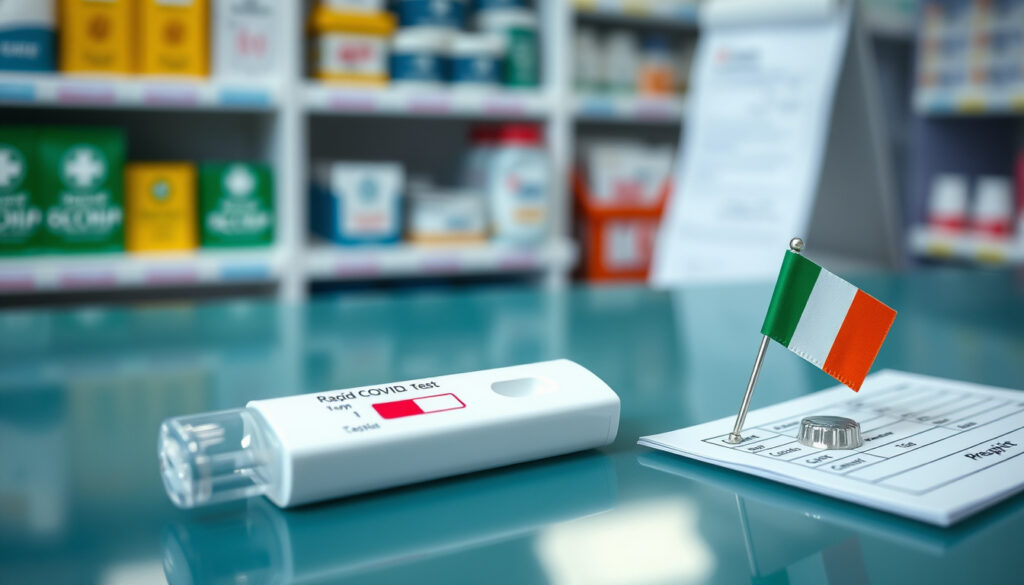
Rapid COVID Testing Near Me: Quick Tests in Ireland
Few things cause more head-scratching in Ireland than figuring out where to pick up a rapid COVID test and whether it’s worth your time, especially now that the HSE no longer provides free antigen tests for most people. This guide walks you through current availability, costs, accuracy, and official guidance so you can make a clear decision.
Rapid antigen test result time: 12-15 minutes ·
Boots lateral flow test price (single): €3 ·
HSE antigen test current status: no longer provided for most ·
Self-testing kits available at Boots: Yes, in-store and online
Quick snapshot
- Boots sells CE-marked Flowflex lateral flow test kits from €3 (Boots Ireland)
- HSE no longer provides free antigen tests for most people (HSE)
- Rapid antigen tests detect current infection, not antibodies (Lenus/HSE programme document)
- Exact stock levels in local pharmacies vary day to day
- Which specific Omicron sub-variants dominate the current wave
- How well current rapid tests detect the latest Omicron sub-variants
- No major timeline changes; testing rules have been stable since 2023
- Antigen tests will remain available over the counter for the foreseeable future
Four key figures summarise the current landscape – from speed to cost to official policy.
| Fact | Value |
|---|---|
| Rapid test result time | 12-15 minutes |
| PCR result time | 24-48 hours |
| HSE free tests ended | 2023 |
| Boots single test price | €3 |
| Rapid test result time (NI guidance) | 30 minutes |
| Self-testing kits at Boots | Yes, in-store and online |
Can COVID be tested immediately?
The short answer is no – testing right after exposure won’t give you a reliable result. The virus needs time to replicate to detectable levels. The HSE (Ireland’s public health authority) advises waiting 3-5 days after exposure for a meaningful antigen test result.
What is the earliest time to test after exposure?
If you know you’ve been in close contact with someone who tested positive, the HSE antigen test validation report notes that a single stand-alone antigen test is not recommended for asymptomatic screening even at day 3. Most people who develop symptoms start testing positive around day 3 or 4 after exposure.
Rapid antigen test window after symptoms
- When symptoms begin, you can test immediately – rapid tests work best in the first 5-7 days of illness.
- If symptoms are mild, wait 24 hours before testing to reduce false negatives.
The catch: Timing is everything – testing too early wastes effort and money.
PCR vs. rapid COVID-19 test: What’s the difference?
A single result time difference tells only half the story – the real gap is in sensitivity and what each test is designed to catch.
Accuracy comparison: PCR versus rapid antigen
One pattern emerges from the data: PCR tests are more sensitive because they amplify genetic material, catching lower viral loads. The Lenus/HSE programme document makes clear that rapid antigen tests should be used only where a clinical pathway exists and operational reasons favour them over PCR. Here’s how they stack up:
| Feature | PCR test | Rapid antigen test |
|---|---|---|
| Result time | 24-48 hours | 12-15 minutes |
| Sensitivity | High (detects low viral loads) | Moderate (best with higher viral load) |
| Cost to consumer | Free (if eligible) or private clinic fee | €3-€15 per kit |
| When to use | Confirm infection, travel requirements | Quick screening, symptomatic cases |
A negative rapid test when you have symptoms is not a green light – the HSE validation report advises symptomatic people with a not-detected antigen test may need a PCR or a second antigen test 2-3 days later.
When to choose PCR vs rapid test
If you need a definitive answer for travel, work, or clinical care, go PCR. For a quick check when symptoms appear, a rapid test gives you a result in minutes – but never rely on a single negative to rule out infection.
The implication: PCR is the gold standard; rapid tests are a useful, fast triangulation tool.
Do boots have COVID tests?
Yes – Boots Ireland stocks home lateral flow testing kits both in-store and online. The Boots Ireland product page lists a Flowflex Antigen Rapid Test Lateral Flow Self-Testing Kit priced at €3 for a single test and multi-pack options are also available. Other retailers like SuperValu and Dunnes occasionally stock similar kits, but availability varies.
Types of COVID tests available at Boots
- Lateral flow self-testing kits (CE-marked, 1-test pack from €3)
- No in-store supervised testing service currently offered (the €35 in-store service reported in 2021 by Irish Pharmacy News appears to have been discontinued)
Boots lateral flow test pricing
Boots offers two main product options:
| Product | Price | Availability |
|---|---|---|
| Flowflex Antigen Rapid Test (1-test pack) | €3 | In-store and online |
| Multi-pack options | Variable (around €10-€20) | Online |
HSE guidance reminds users to check the box has a CE mark and a 4-digit number – a standard required in Ireland but not always present on cheaper imports.
The pattern: Boots is the most consistent pharmacy source in Ireland for these kits, but local stock can dip during winter surges.
What are the very first signs of COVID?
Knowing early symptoms helps you decide when to test. The classic early signs remain a sore throat, runny nose, fever, cough, and loss of taste or smell, according to RTÉ (Ireland’s national public broadcaster). New Omicron sub-variants have also added three more symptoms to the watchlist.
Early symptoms list
- Sore throat (most common early symptom in current waves)
- Runny or stuffy nose
- Fever or chills
- Cough
- Loss of taste or smell (less common now but still indicative)
- Fatigue, headache, muscle aches
New symptoms in 2025 variants
The WHO has noted that later Omicron sub-lineages can present with conjunctivitis (pink eye), skin rashes, and diarrhoea as early signs – these are less typical but worth knowing.
If you wake up with a sore throat and a runny nose, don’t assume it’s a cold – test with a rapid kit to be sure, especially if you’re in contact with vulnerable people.
The catch: Early symptoms are hard to distinguish from a cold; testing is the only reliable differentiator.
Should I test if I feel no symptoms?
It depends on your situation. The HSE (Ireland’s public health authority) does not require COVID testing for most asymptomatic people, but it still recommends testing after a known exposure.
When to test despite no symptoms
- After known exposure: Wait 3-5 days, then test with a rapid antigen kit.
- Before visiting vulnerable individuals: A rapid test offers peace of mind.
- If you work in healthcare or a care setting: Follow your employer’s policy – many still require testing.
HSE guidance on asymptomatic testing
The HSE validation report is firm: a single stand-alone antigen test is not recommended for asymptomatic screening – mainly because most rapid tests miss infections with low viral loads. WHO (World Health Organization, global health guidance) similarly advises self-testing only when symptoms are present or there is a high epidemiological risk.
The implication: For a person with no symptoms and no contact, testing is low-value; save your €3 for when it matters.
How to use a lateral flow test correctly (Step-by-step)
The HSE (Ireland’s public health authority) provides a clear workflow, but many users skip critical steps. Follow these steps for a reliable result:
- Hand hygiene: Wash hands or use hand sanitiser before opening the kit.
- Swab both nostrils – not just one, and not too deep (about 2-3 cm).
- Place swab in the provided liquid and stir for at least 10 seconds.
- Add exactly 4 drops to the test cartridge (most kits specify this).
- Wait for the result time stated in the leaflet – usually 12-15 minutes. Do not read after 30 minutes.
- Dispose of all components in your household waste.
The HSE warns that instructions vary by test brand; always follow the specific leaflet inside the box. A CE-marked kit with a 4-digit number ensures it meets EU standards.
The pattern: Following the exact instructions is crucial for accuracy.
What’s confirmed, what’s still unclear
Confirmed facts
- Rapid antigen tests detect current infection (not antibodies) – HSE
- Boots sells CE-marked lateral flow test kits – Boots Ireland
- HSE no longer provides free tests for most people – HSE
- Children aged 4-12 should do tests with help from a parent or guardian – HSE
What’s unclear
- Exact stock levels of rapid test kits in local pharmacies – varies daily
- Which specific Omicron sub-variant is currently dominant in Ireland
- Whether any single brand of antigen test is more reliable than another – RTÉ reports neither HSE nor Department of Health recommends a specific brand
The implication: While many facts are established, daily variability in supply remains.
Expert perspectives on rapid testing
“Testing for COVID-19 is no longer necessary for most people. But you may want to do your own antigen test.”
“At-home COVID-19 diagnostic tests are safe and effective for self-testing.”
FDA (US Food and Drug Administration) – regulatory perspective
The pattern: Official guidance balances accessibility with caution.
Summary
Rapid antigen tests remain a practical, low-cost tool for managing COVID-19 in Ireland in 2025, but only when used at the right time and with the right expectations. The HSE no longer subsidises them for most people, so you’re paying €3 to €15 out of pocket. The trade-off is speed over sensitivity: a negative rapid test is not a free pass, especially if you have symptoms. For someone in Ireland wondering where to buy a rapid test near them, the clearest answer is Boots – in-store or online, from €3. The choice is simple: test on day 3-5 after exposure or at first symptom, and never rely on a single negative test to skip precautions.
nhs.uk, hiberniamedical.co.uk, facebook.com, chemistconnect.ie, inishpharmacy.com, who.int, boots.com
For those searching for quick results, pharmacies offering rapid COVID tests in Ireland provide a convenient option alongside HSE guidance.
Frequently asked questions
How long after exposure should I take a rapid test?
Wait 3-5 days after exposure for the most reliable result. Testing immediately after exposure may not detect the virus due to incubation period (HSE).
Can I use a rapid test if I have symptoms?
Yes – rapid tests are most accurate when you have symptoms. Test as soon as symptoms begin, ideally within the first 5-7 days (HSE).
Do I need to confirm a positive rapid test with PCR?
HSE guidance states that a positive antigen test is very likely correct. However, if you need official documentation (for travel or work), follow up with a PCR test (HSE).
Are rapid tests covered by insurance or health plan?
No – the HSE no longer provides free antigen tests for most people. You must pay out of pocket at pharmacies or online retailers.
Can children use home rapid test kits?
Children aged 4-12 should be helped by a parent or guardian; those aged 13-16 should be supervised (HSE).
How to dispose of used test kits properly?
Place all used components (swab, cartridge, liquid tube) in your household waste bin. Do not recycle (HSE).
Most common questions have clear answers from HSE guidance.
Related reading: Elaine Angene E coe: FBI Search for COVID Relief Fugitive · RN Jobs Near Me in Ireland: How to Find & Apply
More related posts
 Stranger Things Season 5 Release Date: November 26, 2025
 What Time Is Halftime Show 2026 – Bad Bunny Schedule and Details
 Santa Rosa Beach FL: Cost, Location, and Moving Guide
 Ravens vs Browns Player Stats | Nov 16, 2025
 What Caused the Great Depression: Key Factors Explained
 Tongue and Groove Ceiling: Cost & Installation Guide
 2 oz to ml: Exact US & UK Conversion Guide
 Red White and Royal Blue Movie: Cast, Sequel and More