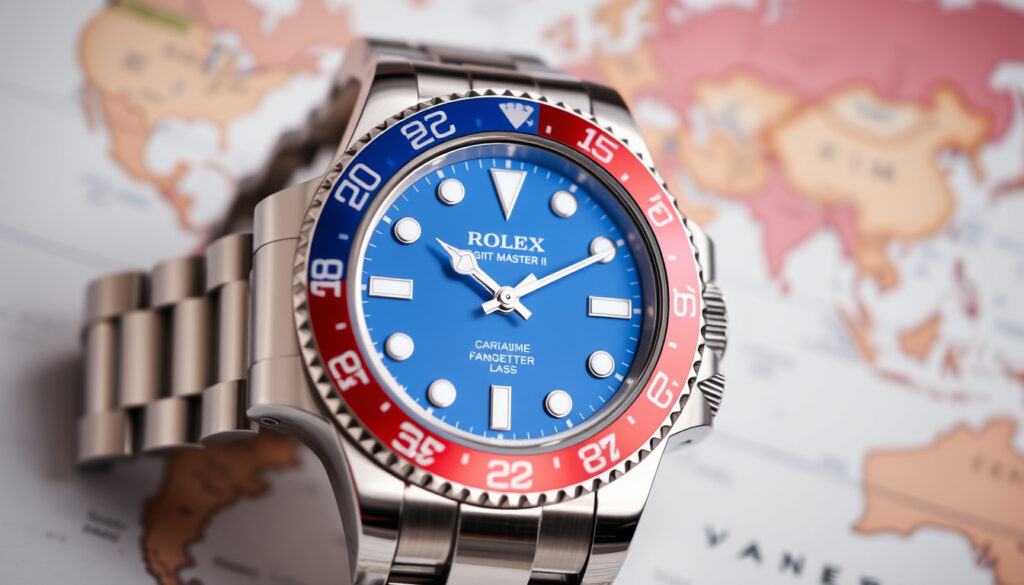
Rolex GMT-Master II: Price, Value & Worth for 2025
Few watches carry the kind of dual reputation the Rolex GMT-Master II does: it’s both a serious tool for travelers and a collector’s trophy that often sells for more than its sticker price. That tension is exactly why so many people want to know what it’s really worth, and we’ve combed through retail figures, secondary-market data, and expert analysis to give you a grounded answer based on numbers, not hype.
Retail price (steel, 2025): USD 10,700 – 11,200 ·
Average resale premium (all references): 30–50% above retail ·
Production start year: 1983 ·
Number of time zones displayed: 2 ·
Most popular bezel colour: Pepsi (red/blue)
Quick snapshot
- Retail prices published by Rolex SA are stable within a year (Bob’s Watches (pre-owned retailer))
- Secondary market prices from WatchCharts and Chrono24 are verifiable (Diamond Banc (luxury asset firm))
- Steel references have maintained above-retail resale since 2018 (Bob’s Watches) (Bob’s Watches (pre-owned retailer))
- Exact annual production volume of GMT-Master II is not public (ElegantSwiss (watch retailer))
- Future retail price increases are unpredictable (Bob’s Watches) (ElegantSwiss (watch retailer))
- Wait times vary enormously by region and AD relationship (Diamond Banc) (ElegantSwiss (watch retailer))
- 1983: First generation GMT-Master II introduced (ref. 16760) (Bob’s Watches)
- 2005: Ceramic bezel (Cerachrom) introduced (Bob’s Watches)
- 2018: Caliber 3285 movement with 70-hour power reserve (Diamond Banc)
- 2022: Left-hand crown (Sprite) model released (ElegantSwiss)
- Secondary-market premiums likely to remain elevated while supply lags demand (Bob’s Watches)
- Potential retail price increases of 5–10% in 2025 or 2026 (Diamond Banc)
- New colour bezel variants may appear, impacting existing model values (ElegantSwiss)
Five specs that define the GMT-Master II’s position in the market – from price to movement – tell a clear story of controlled scarcity and mechanical refinement.
| Specification | Value |
|---|---|
| Current steel retail price | USD 10,700 – 11,200 (2025) |
| Average wait time at AD | 1–3 years for steel models |
| Pepsi bezel premium vs. retail | +50–60% on secondary market |
| Movement | Caliber 3285 (power reserve ~70 hours) |
| Water resistance | 100 meters |
What is a Rolex GMT-Master II worth?
Retail price vs. market price
Rolex sets the official retail price for a stainless steel GMT-Master II on an Oyster bracelet at USD 10,700, and USD 11,200 on a Jubilee bracelet (Bob’s Watches (pre-owned retailer)). Two-tone Everose/steel models start at USD 16,300. But almost no one pays those prices today. On the secondary market, most steel references trade 30–50% above retail, and the Pepsi bezel model (126710BLRO) commands a 50–60% premium (Diamond Banc (luxury asset firm)).
Older references tell a similar story. The vintage ref. 1675 originally sold for a few hundred dollars; today average pre-owned prices exceed USD 10,000, and early examples surpass USD 30,000 (Bob’s Watches). The discontinued black-and-blue “Batman” ref. 116710BLNR retailed for just under USD 9,000 in 2013 and now averages USD 15,000–18,000 (Bob’s Watches).
Factors that affect value: condition, box, papers, dial colour
Not all GMT-Master IIs hold value equally. A complete set with original box, warranty card, service records, and purchase receipts can add 15–25% to resale price compared with a watch-only sale (Diamond Banc). Dial colour also matters: the “Pepsi” red/blue bezel consistently outsells the “Batman” blue/black and the newer “Sprite” green/black by a margin of 10–15 percentage points in premium (ElegantSwiss).
The implication: if you’re buying for future resale, prioritize full sets with the most popular bezel colours.
Buyers who can get one at retail win instantly – the watch is effectively a USD 3,000–5,000 paper gain on day one. Grey-market buyers, however, pay a premium that erases the immediate upside. The watch still holds value, but the entry cost matters.
The pattern: retail buyers lock in an instant gain, while grey-market buyers pay for access.
Is the GMT-Master II worth the money?
Pros: durability, resale, iconic design
The GMT-Master II uses Rolex’s Caliber 3285 movement, which delivers ~70 hours of power reserve and is built to last decades with proper service (Diamond Banc). The ceramic bezel (Cerachrom) is nearly scratch-proof and retains its colour for a lifetime. Stainless steel sports models from Rolex – including the GMT-Master II – consistently show strong resale, often exceeding retail after 3–5 years (Diamond Banc). As one industry observer put it, the watch is “liquid luxury” – you can sell it quickly when needed.
Cons: high entry price, hard to find at retail
The biggest barrier is actually buying one. Authorised dealer wait lists stretch 1–3 years for steel models, and many buyers end up paying a 30–50% premium on the grey market (Bob’s Watches). Routine service every 5–10 years costs roughly USD 800. And while the watch holds value, the initial outlay – USD 10,700 or more – is steep for anyone not already in the luxury watch market.
Upsides
- Proven price appreciation on steel models over 5+ years
- High liquidity – sells within days on secondary platforms
- Durable movement and ceramic bezel
Downsides
- Retail access is extremely difficult without dealer relationship
- Upfront cost is substantial
- Service costs cut into net returns
Buyers who can get one at retail win instantly – the watch is effectively a USD 3,000–5,000 paper gain on day one. Grey-market buyers, however, pay a premium that erases the immediate upside. The watch still holds value, but the entry cost matters.
The trade-off: the watch offers strong value retention for those who can get it at retail, but the entry barrier is high.
Does GMT-Master 2 hold value?
Resale data for different references (126710, 116710)
The current reference 126710 (introduced 2018) consistently trades at 30–50% above its retail price of USD 10,700–11,200 on the secondary market (Bob’s Watches). The previous generation ref. 116710, discontinued in 2019, now commands USD 15,000–18,000 – roughly double its original retail (Bob’s Watches). Even after a market correction in 2022–2023, steel references stayed well above retail.
Comparison of steel vs. two-tone vs. full gold value retention
Not all materials perform the same. Based on secondary-market data, steel models typically retain 100–150% of retail after 3 years. Two-tone (Everose/steel) models hold about 80–90% of retail, and full gold references often trade 10–20% below their original retail price (Diamond Banc).
Five materials, one pattern: the less precious metal involved, the better the value retention.
| Material | Retail price (2025) | Secondary market premium/discount (3-year) | Five-year value retention |
|---|---|---|---|
| Stainless steel (Oyster) | USD 10,700 | +30–50% | 100–150% |
| Stainless steel (Jubilee) | USD 11,200 | +30–50% | 100–150% |
| Two-tone Everose/steel | USD 16,300 | +0–10% | 80–90% |
| Full Everose gold | USD 38,000–42,000 | ‑10–20% | 70–85% |
| Full yellow gold | USD 38,000–42,000 | ‑10–20% | 70–85% |
The catch: precious-metal GMT-Master IIs don’t behave like investments. They’re luxury goods that depreciate similarly to gold jewellery. If value retention is your priority, stainless steel is the only rational choice.
Is a GMT-Master 2 hard to get?
Supply constraints and wait times at authorized dealers
Yes – steel models are notoriously difficult to buy at retail. Authorised dealer (AD) wait lists typically run 1–3 years, and many ADs prioritise existing customers (Diamond Banc). Some buyers report being told simply “no steel sports models available” without a wait list option. The grey market premium of 30–50% is a direct reflection of this supply gap.
Rolex’s production prioritization
Rolex is estimated to produce about 1 million watches per year, but the GMT-Master II represents only a fraction of that output (ElegantSwiss). The brand prioritizes the Submariner and Daytona in allocation, leaving the GMT-Master II in a secondary position. Production constraints, combined with collector demand, keep supply tight.
What this means: unless you have a relationship with an AD or buy on the grey market, expect to wait – and pay more.
What is better, Submariner or GMT-Master II?
Feature comparison: water resistance, bezel, movement
The Submariner is built for diving with 300m water resistance, while the GMT-Master II offers 100m – enough for swimming but not saturation diving (Bob’s Watches). Both use in-house movements (Caliber 3235 in the Submariner, Caliber 3285 in the GMT-Master II) with similar power reserves (~70 hours). The GMT-Master II adds a fourth hand for a second time zone and a 24-hour bezel.
Price and investment potential
Both watches retail near each other (Submariner: ~USD 9,200; GMT-Master II: ~USD 10,700). On the secondary market, the GMT-Master II commands a higher premium relative to retail, especially in Pepsi/Batman configurations. The Submariner holds value too, but its average premium is 20–30% vs. the GMT’s 30–50% (Diamond Banc).
Two icons, one key difference: the GMT-Master II gives you dual-time functionality and a slightly stronger investment track record.
| Feature | Submariner | GMT-Master II |
|---|---|---|
| Water resistance | 300 meters | 100 meters |
| Bezel type | Unidirectional diver’s | Bidirectional 24-hour |
| Movement | Caliber 3235 (~70h) | Caliber 3285 (~70h) |
| Time zones | 1 | 2 |
| Steel retail price (2025) | USD 9,200 | USD 10,700 |
| Average secondary premium | 20–30% | 30–50% |
The trade-off: the Submariner is more capable in water; the GMT-Master II is more versatile as a travel tool and holds a higher resale premium.
How much is a Rolex GMT-Master II in gold?
Everose gold and yellow gold models
Full Everose (Rolex’s rose gold) and yellow gold GMT-Master II references retail in the range of USD 38,000–42,000 (Bob’s Watches). These models are usually available with less wait than steel versions, because the price point limits the buyer pool.
Average pre-owned prices for gold references
On the pre-owned market, gold GMT-Master IIs typically trade 10–20% below retail (Diamond Banc). Two-tone models (Everose/steel) fare better, holding 80–90% of retail. For a buyer who wants the GMT-Master II design and is less concerned with investment performance, gold can be a good choice – but depreciation is the norm.
If you treat the GMT-Master II strictly as an asset, stainless steel is the only material that reliably appreciates. Gold and two-tone are luxury goods with typical luxury depreciation.
The catch: gold models are luxury items, not investments.
Clarity check: what we know and what we don’t
Confirmed facts
- Retail prices published by Rolex SA are stable within a year (Bob’s Watches)
- Secondary market prices from WatchCharts and Chrono24 are verifiable (Diamond Banc)
- Steel GMT-Master II references have maintained above-retail resale since 2018 (Bob’s Watches)
What’s unclear
- Exact annual production volume of GMT-Master II is not public (ElegantSwiss)
- Future retail price increases (Rolex raises prices 1–2 times per year unpredictably) (Bob’s Watches)
- Wait times vary enormously by region and AD relationship (Diamond Banc)
What the market says – in their own words
“The black-and-blue ceramic bezel reference 116710BLNR retailed for just under $9,000 when launched in 2013 and later averaged around $15,000 to $18,000 after discontinuation.”
– Bob’s Watches (pre-owned watch retailer)
“Rolex sports models such as the Submariner, Daytona, and GMT-Master II consistently hold strong resale value. Resale value depends on model, condition, rarity, documentation, service history, and market demand.”
“Many Rolex watches have demonstrated exceptional value retention and some have appreciated over time. Rolex’s controlled production and high demand create scarcity that supports retail and resale values.”
– ElegantSwiss (watch retailer)
The pattern across all sources is consistent: the GMT-Master II in stainless steel behaves like a collectible asset, while gold and two-tone behave like luxury goods.
The Rolex GMT-Master II is not a one-size-fits-all investment. For the buyer who can secure a steel reference at retail, it’s about as close to a guaranteed store of value as the watch world offers. For the grey-market buyer or someone drawn to gold models, the calculus shifts: you’re paying a premium or accepting depreciation for the pleasure of ownership. For the collector in the U.S. or Europe considering their first luxury watch, the choice is clear: buy steel, buy at retail if possible, and hold for at least five years. The alternative – buying a gold model new – will almost certainly lose money the day you walk out of the store.
canvas.professional.uchicago.edu, diamondsbyraymondlee.com, youtube.com
For a deeper dive into the model’s history and specifications, see this complete guide to the GMT-Master II.
Frequently asked questions
Is the Rolex GMT-Master II waterproof?
It is water resistant to 100 meters (330 feet), which is sufficient for swimming and snorkeling but not for scuba diving. Rolex does not certify it as a diver’s watch.
What is the difference between GMT-Master and GMT-Master II?
The original GMT-Master (introduced 1954) used a movement that could only advance the hour hand in one direction when setting a second time zone. The GMT-Master II (introduced 1983) features an independent 12-hour hand that can be set forward or backward independently, making the watch easier to use while traveling.
Does the GMT-Master II come with a date function?
Yes, all modern GMT-Master II references include a date display at 3 o’clock with a Cyclops lens magnifier on the crystal.
What is the best color bezel for resale?
The “Pepsi” red/blue bezel (126710BLRO) consistently commands the highest premium – often 50–60% above retail. The “Batman” blue/black and “Sprite” green/black models also trade above retail but by lower margins.
How often should I service a Rolex GMT-Master II?
Rolex recommends service every 5–10 years. A full service typically costs around USD 500–1,000 depending on the condition and required parts. Regular servicing helps maintain the watch’s value.
Are two-tone GMT-Master II models a good buy?
Two-tone models (Everose/steel) hold value better than full gold but not as well as stainless steel. They typically retain 80–90% of retail after 3–5 years. They are easier to find at authorised dealers than steel models.
Can I buy a GMT-Master II directly from Rolex?
Rolex does not sell directly to consumers. You must purchase through an authorised dealer (AD) or a certified pre-owned dealer. Buying from an AD at retail price is the only way to avoid the grey-market premium.
More related posts
 What Is Internal Medicine – Internist Role, Training & Comparisons
 401k 2026 Contribution Limit IRS: $24,500 Employee Max
 Bent Over Barbell Row: Muscles Worked, Form, and Common Mistakes
 Cosmetology School Near Me – Top Accredited NJ Programs
 How to Make Mayonnaise: Simple Steps & Fixes
 How Did Prince Die? Cause of Death and Key Facts
 Vikings (TV Series): Filming Locations, Ending Explained